Never Potatoes with …
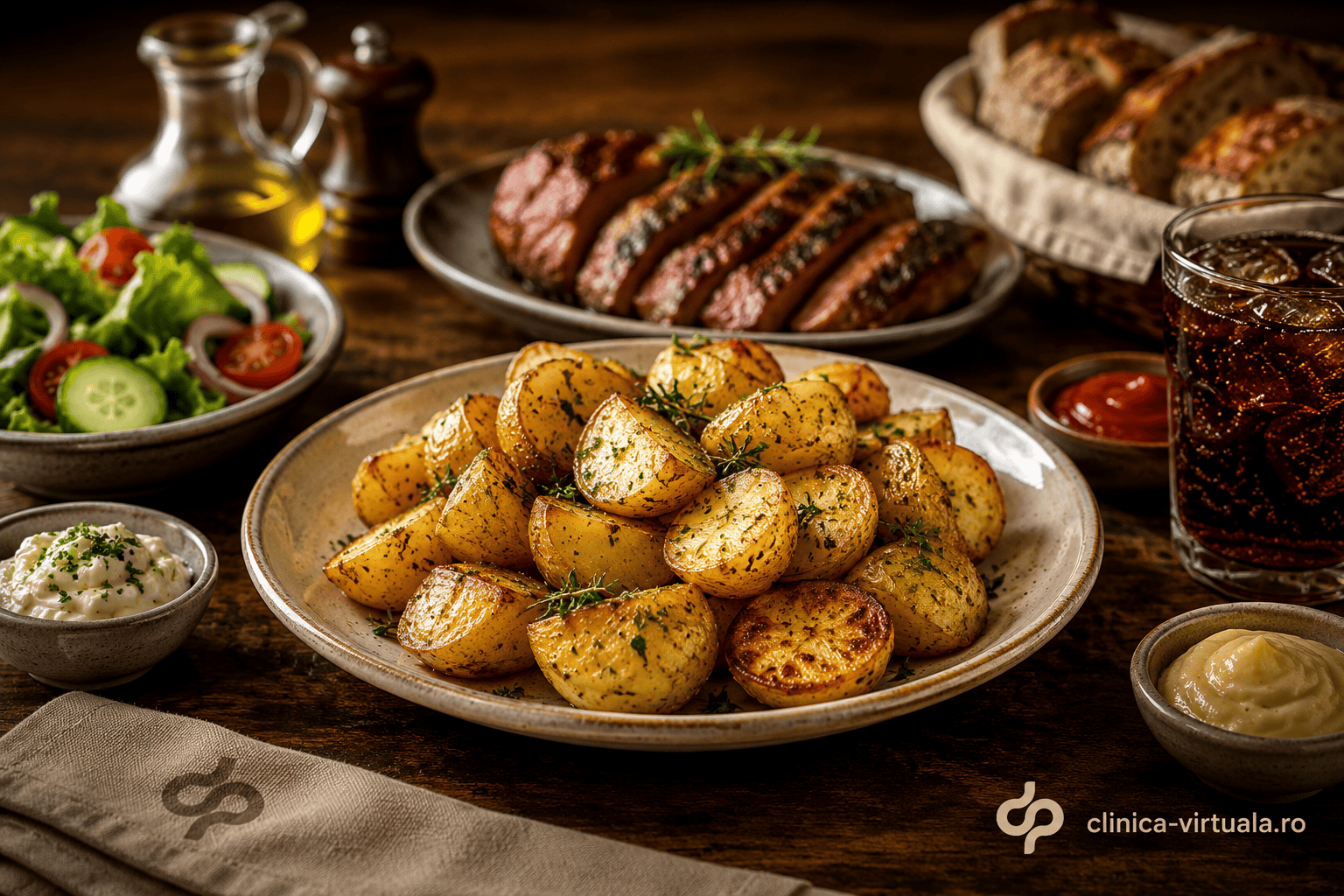
Potatoes are among the most loved—and most unfairly criticized—foods in the world. Over the years, countless nutrition rules have circulated online: “Don’t eat potatoes in the evening,” “Never combine potatoes with meat,” “Don’t mix potatoes with fat,” “Don’t eat potatoes with bread,” and many more.
If we followed every one of these rules, we would probably end up not knowing what we are actually allowed to eat.
But are there really forbidden combinations? Are there foods that should never be eaten with potatoes? Or is this simply another nutrition myth that has spread faster than the scientific evidence behind it?
The answer is more interesting than it may seem.

Tourist in Romania and in need of a prescription for your chronic treatment?
Contact Dr. Petrache’s Virtual Clinic for any medical issue you encounter while in Romania. Send an email to: clinica@diabet-si-nutritie.ro
Why Have Potatoes Earned Such a Bad Reputation?
Potatoes are one of the world’s most important carbohydrate sources. They have fed generations and served as a staple food for millions of people.
The problem is that, over the past few decades, potatoes have become confused with the products made from them:
- French fries
- Potato chips
- Croquettes
- Instant mashed potatoes
- Ultra-processed snacks
When people say that “potatoes make you gain weight,” they are often not referring to boiled or baked potatoes but to versions loaded with oil, salt, and excess calories.
In reality, 100 grams of boiled potatoes contain roughly 80 calories—far fewer than many people imagine.
The Myth: Never Eat Potatoes with Meat
Perhaps the most common nutrition rule is that potatoes should never be eaten together with meat.
Supporters of this idea claim that proteins and carbohydrates require different digestive processes and that the body cannot efficiently digest them together.
The problem is that human physiology simply does not work that way.
Our digestive system is specifically designed to process mixed meals. The stomach secretes multiple digestive substances simultaneously to handle different nutrients.
If this combination were truly harmful, then dishes such as:
- Meat and potatoes
- Fish with boiled potatoes
- Stews containing potatoes and meat
- Soups made with meat and potatoes
would have caused major issues in populations that have consumed them for centuries.
There is no solid scientific evidence showing that the simple combination of meat and potatoes is dangerous.
Then What Is the Real Problem?
Most of the time, the problem is not the combination itself—it is the quantity.
A large serving of French fries alongside a large serving of fatty meat can easily exceed the calorie requirements of an entire meal.
Not because the foods somehow “conflict” with each other.
But because together they provide a very large amount of energy.
For example:
200 g of boiled potatoes plus 150 g of chicken breast is a completely different meal from:
200 g of French fries plus 250 g of pork neck and several rich sauces.
The digestion, calorie load, and metabolic impact are not the same.
Potatoes and Bread—A Forbidden Combination?
Many people have heard that potatoes and bread should never be eaten at the same meal.
Again, this is not a toxic combination.
The issue is that both foods are significant sources of carbohydrates.
If dessert, sweetened beverages, and large portions are added, the meal’s total glycemic load may become quite high.
For someone with diabetes or prediabetes, this may result in substantial blood glucose elevations.
However, this does not mean the combination is “forbidden.”
It simply means that the total carbohydrate intake should be considered.
Potatoes and Fat
This is where things become more interesting.
Potatoes themselves are not particularly high in calories.
However, potatoes have an extraordinary ability to absorb fat.
This is one of the reasons why the difference between boiled potatoes and French fries is so significant.
During frying, potatoes absorb considerable amounts of oil.
As a result, their calorie content can become two or even three times higher than that of plain potatoes.
Therefore, if there is one combination that deserves more attention, it would be:
potatoes + very large amounts of fat.
Not because it is inherently dangerous, but because it becomes extremely calorie-dense.
What About People with Diabetes?
This is one of the questions I receive most frequently.
Many patients believe that a diagnosis of diabetes means the end of potatoes forever.
In reality, things are much more nuanced.
What matters is:
- Portion size
- Cooking method
- The other foods eaten at the meal
- Physical activity
- Medical treatment
Boiled or baked potatoes can absolutely be part of a balanced diet.
French fries consumed frequently and in large quantities, however, are generally a less favorable choice.
Foreigner In Romania and in need of a prescription for your chronic treatment?
Contact Dr. Petrache’s Virtual Clinic for any medical issue you encounter while in Romania. Send an email to: clinica@diabet-si-nutritie.ro
A Surprising Detail: Cooled Potatoes
Few people know that once potatoes are cooled after cooking, part of their starch is converted into what is called resistant starch.
This starch is digested differently and may produce a lower glycemic response compared with potatoes eaten immediately after cooking.
This is one reason why a cold potato salad may have a different metabolic impact than hot mashed potatoes.
It is not a miracle, and it certainly does not turn potatoes into a carbohydrate-free food, but it is an interesting and well-documented phenomenon.
Are There Any Combinations Worth Avoiding?
If we are talking strictly about health and weight management, the least favorable combinations are those that bring together:
- Large amounts of carbohydrates
- Large amounts of fat
- Large amounts of calories
For example:
French fries, white bread, rich sauces, and sugary drinks.
In this case, the problem is not any single food.
The problem is the accumulation of all of them in the same meal.
The body does not recognize “forbidden combinations.”
The body sees energy, nutrients, fiber, and calories.
What Are Smarter Combinations?
For most people, potatoes pair very well with:
- Fish
- Lean meat
- Eggs
- Yogurt
- Vegetables
- Large salads
Protein and fiber contribute to satiety and may reduce hunger after eating.
This is one reason why a plate of baked potatoes with a large salad is very different from a serving of French fries eaten on its own.
Why Do So Many Nutrition Rules Exist?
Our brains love simple explanations.
It is much easier to believe there is a “good” food and a “bad” food than to accept that nutrition is more complex.
The truth is that most modern health problems do not arise because of a single food combination.
They arise from:
- Chronic calorie excess
- Physical inactivity
- Poor sleep
- Stress
- Frequent consumption of ultra-processed foods
Potatoes have often become the scapegoat for problems that have much broader causes.
Passing through Romania and need a prescription for your chronic treatment?
Contact Dr. Petrache’s Virtual Clinic for any medical issue you encounter while in Romania. Send an email to: clinica@diabet-si-nutritie.ro
Conclusion
If you opened this article expecting to discover a food that should never be eaten with potatoes, you may be disappointed.
For most healthy people, there is no magical and dangerous food combination that instantly turns potatoes into an enemy of health.
More important than asking “Never potatoes with…?” is asking:
How large is the portion?
How were they prepared?
What else is on the plate?
How often are they eaten?
Potatoes are not the problem.
Most of the time, the real issue is the overall dietary context in which they are consumed.
When prepared simply, eaten in reasonable portions, and included as part of a balanced diet, potatoes remain one of the most accessible, satisfying, and nutritious foods available.
Follow us on:
- FaceBook: Diabetes & Nutrition;
- YouTube: Diabetes Facts.