

Unique Treatment for Fatty Liver Disease – Coming Soon

What is Fatty Liver Disease
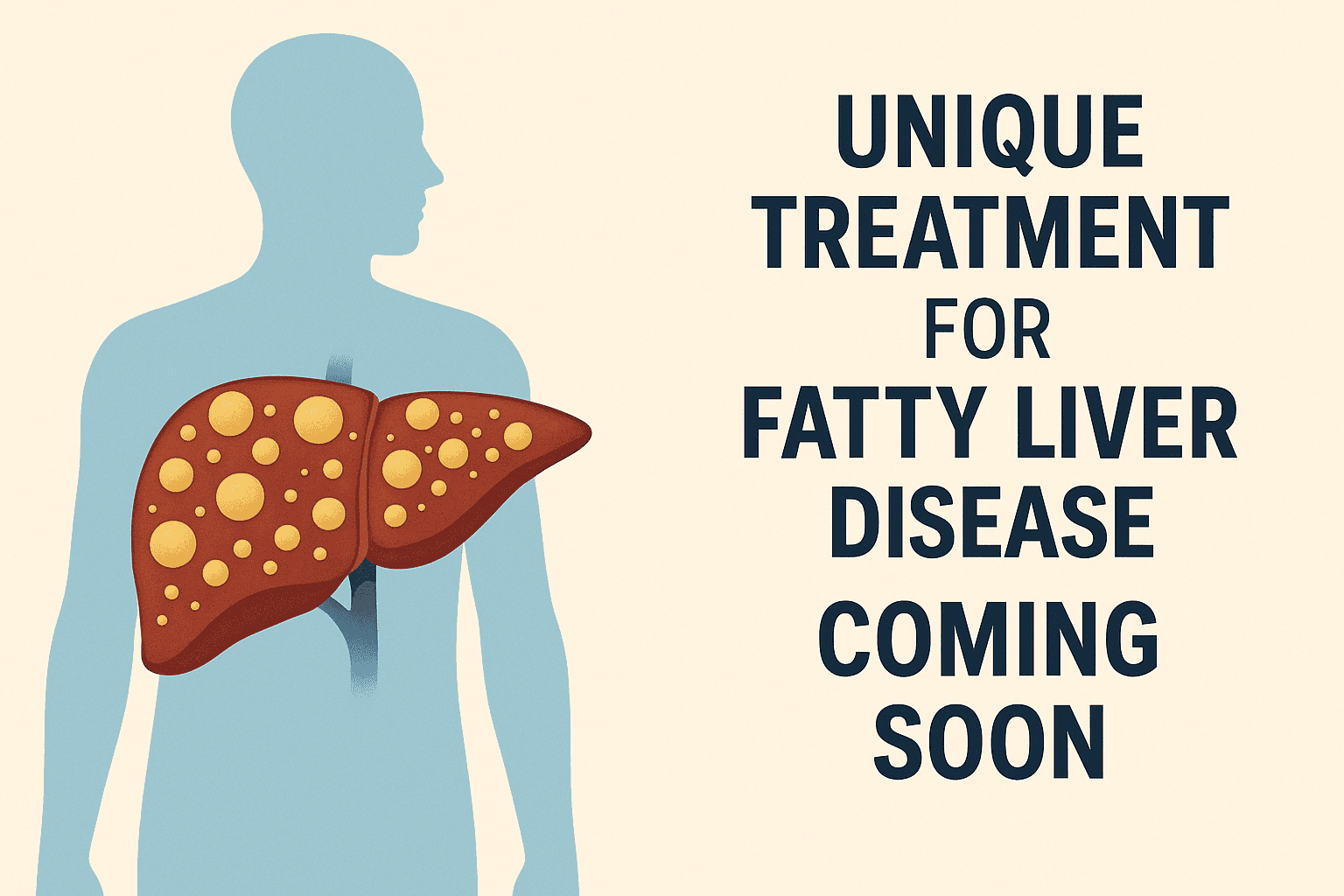
Fatty liver disease, popularly called “fatty liver,” is a condition characterized by the excessive accumulation of fat inside liver cells. Normally, the liver contains a small amount of fat, but when it exceeds 5–10% of the organ’s weight, it is considered steatosis.
Although the condition may seem harmless at the beginning, it can become dangerous over time. Initially, the liver may tolerate fat accumulation without major problems. However, prolonged overload triggers inflammation and gradual destruction of liver cells. This advanced form is called MASH (Metabolic dysfunction-Associated SteatoHepatitis), a recently introduced term that replaces the older NASH.
The disease is closely linked to modern lifestyle: calorie-rich diets, sedentary behavior, obesity, and type 2 diabetes. For this reason, its incidence is increasing worldwide, and specialists consider it a major public health issue.
Foreigner In Romania and in need of a prescription for your chronic treatment?
Contact Dr. Petrache’s Virtual Clinic for any medical issue you encounter while in Romania. Send an email to: [email protected]
Why Fatty Liver is Dangerous
The real danger of fatty liver disease is not the fat itself, but the complications that follow. Over time, chronic inflammation leads to:
- Fibrosis (scarring of liver tissue)
- Cirrhosis (advanced, irreversible stage of liver disease)
- Hepatocellular carcinoma (liver cancer)
For many patients, the diagnosis comes late, when the liver is already seriously affected. Often, the disease causes no pain or obvious symptoms, only vague fatigue.
In addition, fatty liver disease is not isolated. It is part of a broader picture known as metabolic syndrome. This means that patients with MASH often also have abdominal obesity, type 2 diabetes, hypertension, and dyslipidemia. Together, these conditions dramatically increase the risk of heart attack and stroke.
The Magnitude of the Problem
World Health Organization data shows that about one quarter of the world’s population has fatty liver disease, and a portion of them progress to MASH. Recent estimates suggest over 250 million cases of MASH worldwide.
The disease does not affect only the elderly. It is increasingly seen in young adults and even adolescents, especially with the rise of childhood obesity. This makes it particularly alarming: a silent epidemic spreading without people realizing it.
Current Treatment Options
Currently, there are no approved medications that can cure or reverse advanced fatty liver disease. Medical recommendations focus on:
- Weight loss: losing 7–10% of body weight can significantly improve the liver;
- Balanced diet, rich in vegetables, fiber, and lean proteins, while limiting sugar and unhealthy fats;
- Regular exercise: at least 150 minutes of moderate activity per week;
- Managing diabetes and dyslipidemia with specific therapies.
These measures are effective but difficult to sustain long-term for many patients. That is why the arrival of a safe, effective medication would represent a paradigm shift.
Passing through Romania and need a prescription for your chronic treatment?
Contact Dr. Petrache’s Virtual Clinic for any medical issue you encounter while in Romania. Send an email to: [email protected]
A New Drug – Real Hope
Akero Therapeutics has developed an innovative drug that is now in clinical trials. Preliminary results suggest it could be the first treatment capable of reversing liver damage caused by MASH.
Unlike other therapies tested in the past, Akero’s drug targets not only fat reduction but also decreases inflammation and repairs scar tissue. Clinical trials so far have demonstrated:
- Reduction of fibrosis;
- Improvement in liver inflammation;
- Better liver function;
- Good tolerability and safety profile.
These results have attracted international attention and led one of the world’s largest pharmaceutical companies to take a decisive step.
Novo Nordisk’s Involvement
In 2025, Novo Nordisk announced the acquisition of Akero Therapeutics. Novo is already a global leader in diabetes and obesity treatments, and this acquisition shows their clear strategy: to also lead in related metabolic liver diseases.
For patients, this means:
- the drug will benefit from Novo’s financial and scientific resources;
- research and development could accelerate;
- there is potential for combination therapies with GLP-1 drugs (such as semaglutide or tirzepatide), which are already successful in diabetes and obesity.
This integrated approach could revolutionize the treatment of metabolic diseases.
The Stage of Clinical Trials
The development of a drug is a long and rigorous process designed to ensure safety and effectiveness. It involves several phases:
- Phase I: tested on a small group of healthy volunteers or patients to evaluate safety and dosage.
- Phase II: tested on a few hundred patients to observe efficacy and potential side effects.
- Phase III: tested on thousands of patients across many countries to confirm effectiveness, safety, and comparison with existing standards of care.
- Phase IV: post-marketing monitoring to assess long-term effects.
Akero’s drug is currently in Phase III, the final stage before official submission for approval to regulatory agencies (FDA in the US, EMA in Europe). This is a decisive step: if results confirm its efficacy and safety, the drug could be approved.
Transitioning from Phase III to approval usually takes 1–3 years, depending on trial complexity and regulatory speed.
Why This Matters
The fact that the drug is already in Phase III means it has passed preliminary safety and efficacy tests. This is not just a promising idea but a concrete project supported by a global pharmaceutical leader.
For patients, it means that within a few years, there may finally be a treatment not only to slow the disease but to actually reverse it.
Passing through Romania and need a prescription for your chronic treatment?
Contact Dr. Petrache’s Virtual Clinic for any medical issue you encounter while in Romania. Send an email to: [email protected]
Impact on Patients
An effective treatment for MASH would have a tremendous impact:
- reducing the number of patients progressing to cirrhosis or liver cancer;
- decreasing the need for liver transplants, which are scarce and risky;
- improving quality of life for millions of people;
- offering hope to younger patients diagnosed early.
Moreover, by integrating with diabetes and obesity treatments, patients could benefit from a comprehensive approach to all associated metabolic conditions.
What Patients Can Do in the Meantime
Even though the drug is in advanced trials, it will still take time before it becomes available. Meanwhile, patients can actively protect their liver by:
- maintaining a healthy weight;
- adopting a balanced diet (Mediterranean style, high in fiber, vegetables, fruits, lean proteins);
- limiting alcohol intake;
- engaging in daily physical activity;
- strictly controlling diabetes and blood pressure;
- undergoing regular liver monitoring (blood tests, ultrasound).
Tourist in Romania and in need of a prescription for your chronic treatment?
Contact Dr. Petrache’s Virtual Clinic for any medical issue you encounter while in Romania. Send an email to: [email protected]
Conclusion
Fatty liver disease and its advanced form, MASH, are silent but serious conditions. Until now, patients could only rely on lifestyle changes. The future, however, holds real hope: a unique treatment capable of reversing liver damage.
The fact that this drug is already in Phase III trials and supported by a global giant like Novo Nordisk shows that we are on the verge of a medical revolution. In the coming years, millions of patients may benefit from this breakthrough, and the management of metabolic diseases could be transformed.
Until then, lifestyle care remains essential: proper nutrition, exercise, and controlling associated diseases are the best tools to protect liver health.
Follow us on:
- FaceBook: Diabetes & Nutrition;
- YouTube: Diabetes Facts.


