False low readings on your sensor at night?
If you use a glucose sensor, chances are you’ve experienced something that made you uneasy. You may have been woken up in the middle of the night by an alarm, or you noticed in the morning that your graph shows low values during sleep, sometimes repeated, sometimes without any clear explanation.
The first reaction is completely natural. You think about hypoglycemia, about possible risks, and about whether you might have had an episode without realizing it. In some cases, this can even lead to immediate action—eating, correcting, or changing something in your routine.
In reality, many of these episodes are not true hypoglycemia. They are false readings generated by how the sensor behaves under certain conditions, especially during sleep.

Foreigner In Romania and in need of a prescription for your chronic treatment?
Contact Dr. Petrache’s Virtual Clinic for any medical issue you encounter while in Romania. Send an email to: clinica@diabet-si-nutritie.ro
What actually happens at night
To understand this, it’s important to start with a key fact: a glucose sensor does not measure blood glucose directly. It measures glucose in the interstitial fluid—the fluid between your cells. This fluid reflects blood glucose, but it is not identical and does not respond instantly to changes.
During the day, these differences are usually small and easy to interpret. At night, however, an additional factor comes into play: body position.
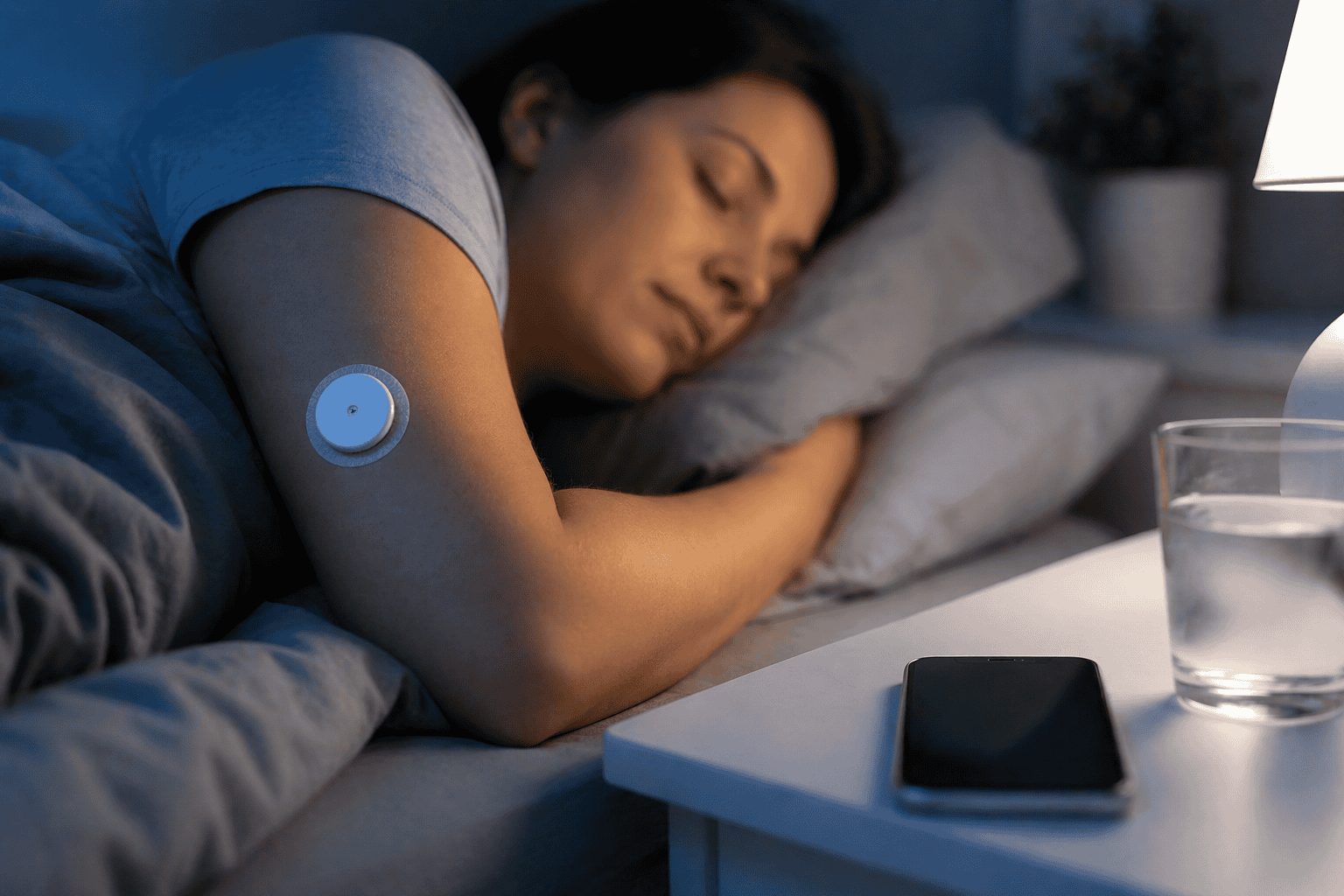
Without realizing it, you change positions multiple times while sleeping. If you end up lying on the side where the sensor is placed, that area is exposed to constant pressure. This pressure temporarily alters local circulation and the flow of interstitial fluid.
For the sensor, this results in an artificially low glucose reading—not because your glucose has actually dropped, but because the environment it is measuring has changed.
Why the sensor shows low values when your glucose is normal
Under normal conditions, interstitial fluid is in dynamic balance with the blood. Glucose moves between these compartments, and the sensor reflects that level.
When pressure is applied to the area, this exchange is disrupted. The flow slows down, and the glucose concentration in that local tissue may appear lower than it really is. The sensor does not “know” that this is caused by pressure—it simply reports what it detects.
This phenomenon is commonly known as “compression lows” and is one of the most frequent causes of false nighttime readings.
Tourist in Romania and in need of a prescription for your chronic treatment?
Contact Dr. Petrache’s Virtual Clinic for any medical issue you encounter while in Romania. Send an email to: clinica@diabet-si-nutritie.ro
How to recognize a false low
These episodes tend to follow a recognizable pattern. The drop often happens relatively quickly, without a long gradual decline. Values may enter the hypoglycemic range, sometimes even triggering alarms.
Just as important is how the episode ends. In many cases, the values return to normal just as quickly, without any intervention. This often coincides with a change in your sleeping position, even if you don’t remember it.
Another key clue is the absence of symptoms. True hypoglycemia—especially significant episodes—is usually accompanied by signs such as sweating, trembling, palpitations, or discomfort. If these are completely absent, the reading may not reflect reality.
Why these readings can be misleading
The problem is not just that these values appear, but how they are interpreted. When you see a low number on the screen, the instinct is to treat it as a fact. The sensor feels objective and precise, which makes it easy to forget its limitations.
Without a clear explanation, many people start questioning their diet, their treatment, or even the progression of their condition. This can lead to unnecessary changes—nighttime snacking, dose adjustments, or increased anxiety around sleep.
Over time, these reactions can do more harm than good. They may destabilize glucose control and reduce confidence in both the device and your own perception.
What happens if you treat a false low
If you treat a false low as a real one, you will likely consume carbohydrates. At that moment, your actual glucose level may already be normal. The result is an unnecessary rise, sometimes even above your target range.
By morning, you may see higher glucose values and interpret the situation as instability, without realizing that the intervention was triggered by inaccurate data.
Repeated over time, this pattern can lead to unnecessary variability and frustration.
How to better interpret nighttime readings
Experience plays an important role. As you continue using a sensor, you begin to recognize patterns. However, a few simple principles can help.
Context matters. If low values appear only during sleep, without an obvious reason, and you feel well in the morning, this is an important clue. The shape of the graph also matters: sudden drops followed by quick recovery are typical for these situations.
If you are unsure, a fingerstick measurement can help clarify the situation, especially if you wake up during the episode. Large differences between the two methods in this context are suggestive of a false reading.
Passing through Romania and need a prescription for your chronic treatment?
Contact Dr. Petrache’s Virtual Clinic for any medical issue you encounter while in Romania. Send an email to: clinica@diabet-si-nutritie.ro
What you can do
There is no need for complicated solutions. First, try to avoid sleeping directly on the side where the sensor is placed. This is not always easy to control, but even being aware of it can reduce how often these episodes occur.
The placement of the sensor also matters. Choosing areas less exposed to pressure during sleep can improve stability.
Just as important, avoid reacting automatically to every nighttime alarm. If you have no symptoms and the situation seems unusual, take a moment to evaluate before acting.
Trusting your body
The sensor is a valuable tool, but it should not completely replace your own perception. Your body’s signals still matter. If you have no symptoms of hypoglycemia, it is unlikely that a severe episode has occurred.
Finding a balance between technology and personal awareness is key to proper interpretation.
Conclusion
Low values shown by your sensor at night do not always mean true hypoglycemia. In many cases, they are caused by pressure on the sensor during sleep and reflect a technical limitation rather than a metabolic problem.
Understanding this helps you avoid unnecessary interventions, reduce anxiety, and use your sensor more effectively.
Sometimes, the difference between a real alert and a false one has nothing to do with your glucose—and everything to do with how you’re sleeping.
Follow us on:
- FaceBook: Diabetes & Nutrition;
- YouTube: Diabetes Facts.