Green or Yellow Kiwi in Diabetes
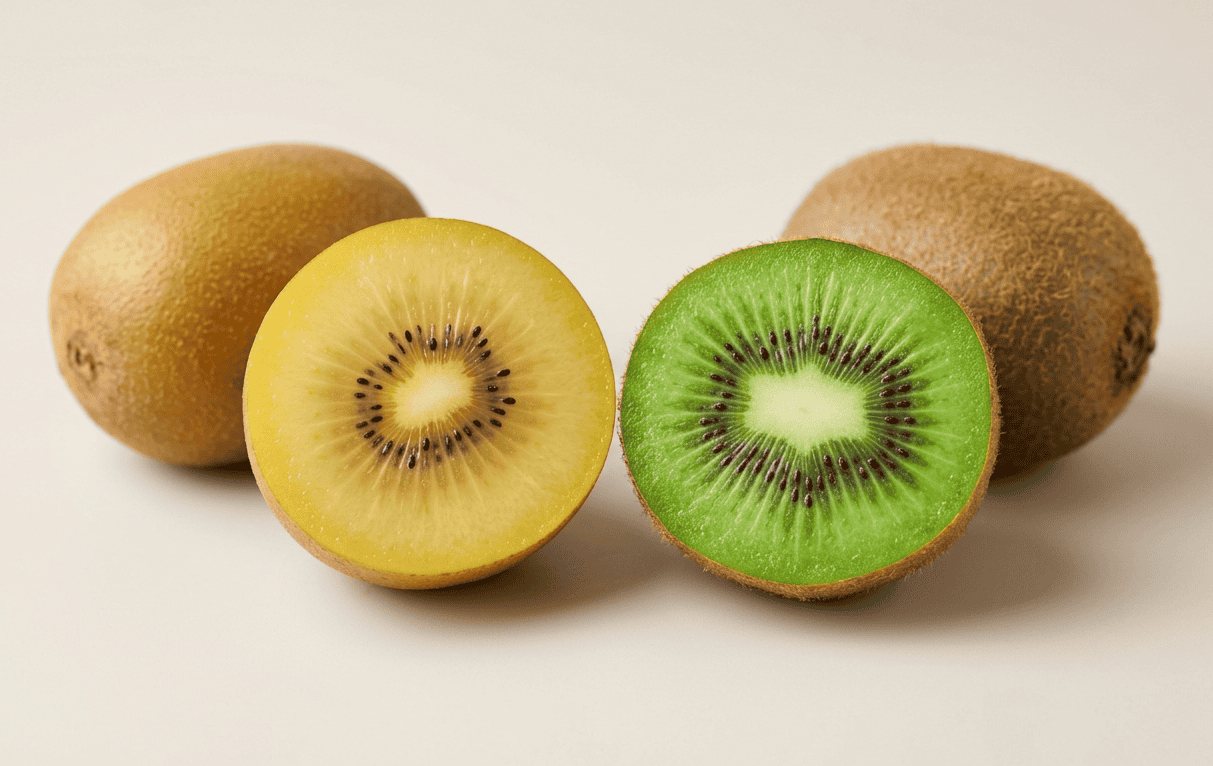
Choosing fruits in diabetes is never random. While the general recommendation is clear—fruits can be part of a balanced diet—the differences between them can significantly influence blood glucose levels. Kiwi is often considered a “safe” fruit, but few patients realize that there are two main types, with slightly different profiles: green kiwi and yellow (golden) kiwi. So the natural question is: does this difference really matter in diabetes?
The answer is yes—and the details matter.

What Does Kiwi Contain and Why It Matters in Diabetes
Regardless of color, kiwi is a nutrient-dense fruit. It is rich in vitamin C, antioxidants, potassium, and fiber, making it a valuable addition even for people with diabetes.
At the same time, kiwi contains carbohydrates in the form of natural sugars. This means it will affect blood glucose. The difference between a “diabetes-friendly” fruit and a problematic one is not whether it contains sugar, but how quickly and how much it raises blood glucose levels. This is where concepts like glycemic index and glycemic load become important.
Foreigner In Romania and in need of a prescription for your chronic treatment?
Contact Dr. Petrache’s Virtual Clinic for any medical issue you encounter while in Romania. Send an email to: clinica@diabet-si-nutritie.ro
Green Kiwi – The More Balanced Option
Green kiwi is the most common variety. It has bright green flesh, small black seeds, and a slightly tangy taste.
From a metabolic perspective, it offers several advantages.
It contains more fiber than yellow kiwi, which slows carbohydrate absorption and leads to a more gradual rise in blood glucose. Its glycemic index is moderate, around 50, making it a relatively safe option for most people with diabetes.
Its less sweet taste also has a behavioral advantage: it reduces the tendency to overconsume. Sweeter foods are often eaten more quickly and in larger quantities, which can destabilize blood glucose.
For patients aiming for tighter glycemic control, green kiwi is generally the safer choice.
Yellow Kiwi – Sweeter, More Appealing, but Different Impact
Yellow kiwi, also known as golden kiwi, has a golden-yellow flesh and a noticeably sweeter taste. Many people find it more pleasant and easier to eat.
However, this sweetness comes with a metabolic trade-off.
It contains slightly more natural sugars and less fiber compared to green kiwi. Its glycemic index is somewhat higher, typically between 55 and 60. The difference is not dramatic, but it becomes relevant for patients who are sensitive to glycemic fluctuations or who consume larger portions.
On the positive side, yellow kiwi is even richer in vitamin C and antioxidants, making it nutritionally attractive. The issue is not that it should be avoided, but that it requires more attention.
The Real-Life Difference
For a person with diabetes, the difference between green and yellow kiwi is practical, not just theoretical.
If you eat a green kiwi, your blood glucose will usually rise more slowly and predictably. With yellow kiwi, there is a slightly higher chance of a faster increase, especially if it is eaten alone on an empty stomach.
In reality, however, the impact depends on several factors: time of day, food combinations, physical activity, and most importantly, individual response. Some patients tolerate yellow kiwi very well, while others clearly see the difference on continuous glucose monitoring.
Tourist in Romania and in need of a prescription for your chronic treatment?
Contact Dr. Petrache’s Virtual Clinic for any medical issue you encounter while in Romania. Send an email to: clinica@diabet-si-nutritie.ro
Portion Size – The Key Factor
One essential aspect, often overlooked, is quantity. The main issue is not the type of kiwi, but the portion size.
One small to medium kiwi, whether green or yellow, is usually well tolerated. Problems tend to appear when intake increases to two, three, or more fruits in a single sitting, especially without pairing them with other macronutrients.
In diabetes, the fundamental rule remains: portion control matters more than choosing the “perfect” food.
How Food Combinations Affect Blood Glucose
Another key factor is how kiwi is consumed.
If eaten alone on an empty stomach, carbohydrate absorption is faster and blood glucose may rise more sharply. If combined with protein or fat—such as Greek yogurt, nuts, or seeds—digestion slows down and the glycemic impact becomes milder.
This strategy applies to all fruits, but it is especially important for sweeter varieties like yellow kiwi.
Kiwi and Weight Management
A major advantage of kiwi, in general, is its relatively low calorie content and its fiber. These contribute to satiety and can help control appetite.
Green kiwi, due to its higher fiber content, may have a slightly stronger effect in reducing hunger. In the context of modern weight-loss treatments, such as GLP-1 receptor agonists, choosing foods with low energy density and controlled glycemic impact becomes even more relevant.
Are These Differences Important for Everyone?
Not necessarily. The differences between green and yellow kiwi are real, but not dramatic. For a patient with well-controlled diabetes, who is active and mindful of their diet, both options can be included without major concerns.
For patients with unstable blood glucose, marked insulin resistance, or high glycemic variability, choosing green kiwi may be the more prudent option.
What truly matters is personalization. There is no universal rule that applies equally to everyone.
The Role of Glucose Monitoring
If you want a clear answer for yourself—not just a general recommendation—the best tool is glucose monitoring.
Whether you use a glucometer or a continuous glucose monitor, you can directly observe how your body responds to green versus yellow kiwi. This is, by far, the most valuable information.
Often, individual variability is greater than the theoretical differences described in nutrition guidelines.
Passing through Romania and need a prescription for your chronic treatment?
Contact Dr. Petrache’s Virtual Clinic for any medical issue you encounter while in Romania. Send an email to: clinica@diabet-si-nutritie.ro
Conclusion – What Should You Choose?
If you have to choose between the two, green kiwi is generally the safer option in diabetes due to its higher fiber content and slightly lower glycemic impact.
Yellow kiwi is not forbidden, but it requires more attention to portion size and context.
Ultimately, diabetes management is not about eliminating foods, but about making smart, consistent decisions. Kiwi can absolutely be part of those decisions—as long as it is consumed in moderation and within the right context.
Follow us on:
- FaceBook: Diabetes & Nutrition;
- YouTube: Diabetes Facts.