Sucralose – Everything You Need to Know

What is sucralose?
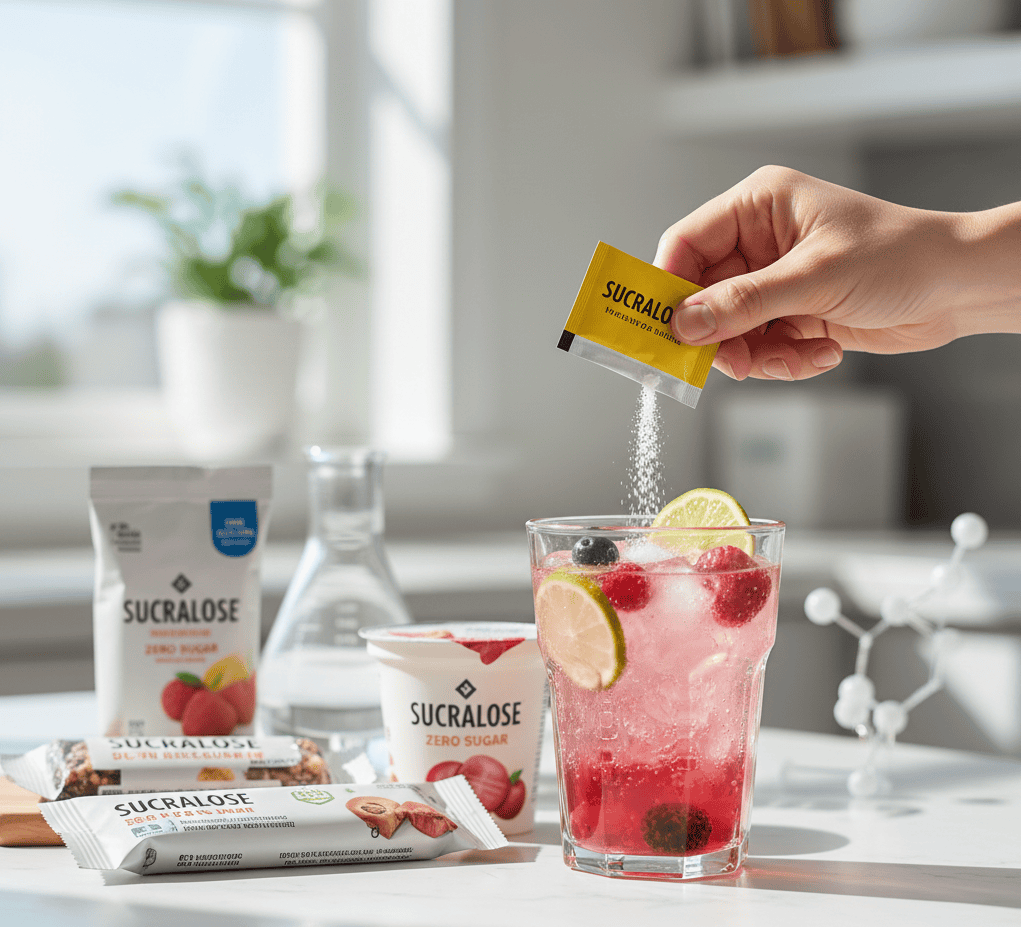
Sucralose is an intense artificial sweetener discovered in 1976 by a team of British researchers working on new sugar-based compounds. Unlike other synthetic sweeteners, sucralose is derived directly from sucrose but undergoes a chemical process in which three hydrogen-oxygen groups are replaced with chlorine atoms. This modification makes sucralose about 600 times sweeter than sugar and impossible for the body to metabolize.
The result is a compound that tastes very similar to sugar but contains no calories and has no effect on blood glucose levels. This profile has made sucralose one of the most popular sweeteners worldwide, used both in the food industry and by consumers in everyday products.
Foreigner In Romania and in need of a prescription for your chronic treatment?
Contact Dr. Petrache’s Virtual Clinic for any medical issue you encounter while in Romania. Send an email to: clinica@diabet-si-nutritie.ro
How sucralose is produced?
The production process starts from sucrose, which undergoes selective chlorination. The resulting sucralose is purified and then crystallized or combined with other sweeteners or bulking agents (such as maltodextrin) to make it easier to use in food and beverages.
Although synthetic, the final compound is stable and has undergone extensive toxicological testing before being approved for consumption.
Glycemic index and caloric value
One of the greatest advantages of sucralose is that it has a glycemic index of zero. It is not metabolized by the body and therefore does not affect blood glucose levels or insulin secretion. This makes it suitable for people with diabetes as well as those following low-carb or ketogenic diets.
Sucralose also has no calories. The minimal energy content comes from the bulking agents it is sometimes combined with, such as maltodextrin, but this does not significantly affect the diet.
Safety of sucralose consumption
Sucralose has been rigorously tested in over 100 human and animal studies before being approved for use. The European Food Safety Authority (EFSA) and the U.S. Food and Drug Administration (FDA) concluded that sucralose is safe for the general population. The acceptable daily intake (ADI) has been set at 15 mg/kg body weight per day—a threshold difficult to reach through normal dietary intake.
Earlier findings showed that sucralose is not carcinogenic, does not affect fertility, and does not cause congenital malformations. It also does not accumulate in the body, being excreted mostly unchanged.
Passing through Romania and need a prescription for your chronic treatment?
Contact Dr. Petrache’s Virtual Clinic for any medical issue you encounter while in Romania. Send an email to: clinica@diabet-si-nutritie.ro
New findings: sucralose-6-acetate
Recent studies (2023) from North Carolina State University and UNC Chapel Hill examined a compound called sucralose-6-acetate, which forms during the production of sucralose and can also appear as a metabolite in the body.
The findings revealed that this compound:
- is genotoxic (can damage DNA) in laboratory cell studies,
- activates genes linked to inflammation and oxidative stress,
- raises theoretical concerns about cancer risk.
Although manufacturers claim the purification process removes most of it, traces may still remain. This does not immediately change sucralose’s legal safety status, but experts recommend caution with excessive, long-term use.
Benefits of sucralose
Even with the new findings, sucralose continues to offer key advantages:
- Extremely sweet – about 600 times sweeter than sugar.
- Zero calories – does not add energy to the diet.
- Glycemic index zero – safe for people with diabetes.
- Sugar-like taste – without bitterness or metallic notes.
- Heat stability – suitable for baking and cooking.
Sucralose and diabetes
For people with diabetes, sucralose remains a helpful sugar alternative that does not raise blood glucose or insulin levels. Its stability at high temperatures makes it a better choice than sweeteners like aspartame when cooking or baking.
However, given the recent discoveries, it is wise to alternate with natural options such as stevia or monk fruit, especially for those who use sweeteners daily.
Limitations and possible side effects
- May alter gut microbiota diversity in very high doses (observed in animal studies).
- Can cause bloating or digestive discomfort in sensitive individuals.
- When consumed with highly processed foods, it may affect insulin response in some people.
- Potential exposure to sucralose-6-acetate raises concerns about long-term effects.
Comparison with other sweeteners
- Versus sugar – zero calories and no glycemic impact.
- Versus aspartame – heat-stable, unlike aspartame.
- Versus stevia – closer to sugar in taste.
- Versus saccharin – without metallic aftertaste.
- Versus sugar alcohols (erythritol, xylitol) – no calories and generally better tolerated.
Who should be cautious
- People who consume large amounts of artificial sweeteners daily.
- Individuals with digestive issues or microbiome imbalances.
- Pregnant women and children – although not prohibited, natural alternatives may be preferred.
Myths and truths about sucralose
- “Sucralose causes cancer” – no direct evidence in humans, but recent studies raise caution.
- “Sucralose is natural” – false, it is a synthetic derivative of sugar.
- “It cannot be used for cooking” – false, it is heat-stable.
- “It has zero calories” – true, the body does not metabolize it.
Tourist in Romania and in need of a prescription for your chronic treatment?
Contact Dr. Petrache’s Virtual Clinic for any medical issue you encounter while in Romania. Send an email to: clinica@diabet-si-nutritie.ro
Conclusions
Sucralose remains one of the most widely used artificial sweeteners, appreciated for its sugar-like taste, zero calories, and approval by major health authorities. Still, the recent discovery regarding sucralose-6-acetate highlights the need for moderation and further research.
For people with diabetes or those trying to reduce sugar intake, sucralose can be a practical tool when used occasionally and responsibly. At the same time, diversifying sweetener use with natural alternatives such as stevia or monk fruit is recommended.
In summary, sucralose can be part of a balanced lifestyle, but it should not become the sole source of sweetness.
Follow us on:
- FaceBook: Diabetes & Nutrition;
- YouTube: Diabetes Facts.