Should You Wash Chicken or Not?

Why This Topic Creates So Much Debate
Few kitchen topics create as much discussion as the question: “Should chicken be washed before cooking or not?”
For many people, the answer seems obvious. They grew up watching parents and grandparents rinse chicken under running water before cooking it. For some, the idea of placing unwashed chicken directly into a pan or oven feels almost wrong. The habit is associated with cleanliness, hygiene, and the feeling that the food is safer to eat.
However, modern food safety recommendations say the exact opposite: raw chicken should not be washed before cooking.
At first glance, this sounds strange. How could not washing chicken possibly be safer? Shouldn’t water remove bacteria? In reality, the issue is much more complex and has to do with how microorganisms spread around the kitchen.
Tourist in Romania and in need of a prescription for your chronic treatment?
Contact Dr. Petrache’s Virtual Clinic for any medical issue you encounter while in Romania. Send an email to: clinica@diabet-si-nutritie.ro
What Bacteria Can Be Found on Raw Chicken
Raw chicken may contain bacteria such as Salmonella or Campylobacter. These microorganisms are not always visible and do not necessarily change the appearance of the meat.
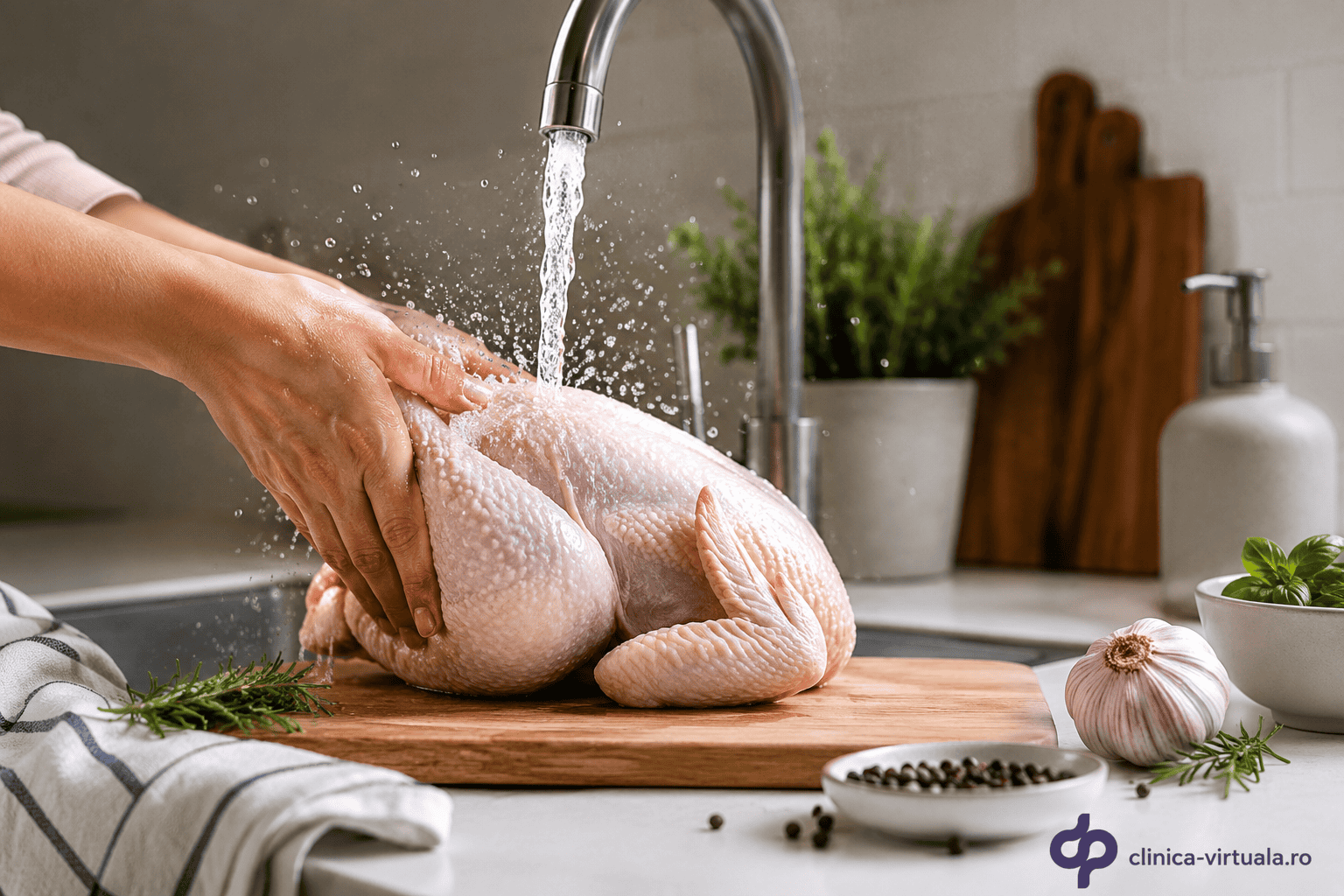
The problem is that rinsing chicken with water does not effectively remove them. Cold water does not sterilize or disinfect the meat. Instead, it may spread bacteria around the kitchen without you even noticing.
Many people assume that water “cleans” chicken microbiologically. In reality, bacteria may still remain on the meat even after rinsing.
The Real Problem: Microscopic Water Droplets
This is one of the most important parts of the discussion.
When raw chicken is washed under running water, countless microscopic droplets are created. These droplets may carry bacteria onto the sink, countertops, sponges, hands, faucets, utensils, or even nearby foods.
Sometimes contamination happens without anyone realizing it.
Many people think the danger comes only from the chicken itself. In reality, the major issue is often cross-contamination.
For example, if bacteria reach a salad that will not be cooked afterward, the risk may become greater than the risk posed by properly cooked chicken.
Why Modern Recommendations Say Not to Wash Chicken
This is why many food safety organizations recommend avoiding washing raw chicken.
Not because bacteria do not exist, but because water may spread them throughout the kitchen.
Another important point is that bacteria on chicken are destroyed by proper cooking temperatures. Heat is what makes chicken safe to eat — not running water.
For this reason, what truly matters is:
proper cooking, careful handling of raw meat, and maintaining clean kitchen surfaces.
What If the Chicken Has Liquid or an Unusual Smell?
Many people continue washing chicken because they believe it removes blood, odor, or impurities. Sometimes there is liquid inside the packaging, which creates the instinct to rinse it.
However, if the chicken has an unusual smell or suspicious appearance, the real issue may be freshness rather than the fact that it has not been washed.
Rinsing does not make spoiled meat safe.
Foreigner In Romania and in need of a prescription for your chronic treatment?
Contact Dr. Petrache’s Virtual Clinic for any medical issue you encounter while in Romania. Send an email to: clinica@diabet-si-nutritie.ro
Do Lemon and Vinegar “Disinfect” Chicken?
Some people use lemon juice, vinegar, or salted water to “clean” chicken. In most cases, these practices are more related to tradition, flavor, or texture than actual sterilization.
They do not guarantee the elimination of harmful bacteria.
Marinating may improve taste and texture, but it does not replace proper cooking.
Cross-Contamination – The Real Danger
One of the most important ideas is that people do not always become sick from undercooked chicken itself.
Sometimes the problem occurs because bacteria spread onto:
salads, fruits, utensils, cutting boards, refrigerator handles, phones, or kitchen sponges.
Cross-contamination can happen very easily whenever raw meat is handled improperly.
That is why kitchen hygiene is extremely important.
What Is More Useful Instead
In practice, the measures that truly matter are quite simple.
It is much more helpful to:
use separate cutting boards for raw meat, wash your hands thoroughly after handling chicken, clean kitchen surfaces carefully, and avoid contact between raw meat and foods that will not be cooked afterward.
If there is excess liquid on the meat, it can be gently removed using paper towels that are discarded immediately afterward.
This reduces moisture without spreading bacteria through water splashes.
“But Our Grandparents Always Washed Chicken”
This is one of the most common arguments.
It is true that this habit has existed for generations. However, many mild foodborne illnesses are never recognized as such. People often assume they simply had indigestion or temporary digestive discomfort.
Modern food safety systems aim to reduce risks as much as possible, even if problems do not occur every single time.
Is Chicken a Dangerous Food?
No.
Chicken can absolutely be part of a healthy and balanced diet. It is an excellent source of protein and is widely used in nutritious meal plans.
The issue is not chicken itself, but improper handling of raw poultry.
In fact, most problems arise not because of the food itself, but because of how it is prepared in the kitchen.
Why This Topic Creates Strong Reactions
This topic generates strong opinions because many people confuse the feeling of cleanliness with real microbiological safety.
Chicken may appear “cleaner” after being rinsed, but that does not automatically make it safer.
In some situations, washing may actually increase risk by spreading microorganisms around the sink area.
In the kitchen, things that seem intuitive are not always the safest choices.
Passing through Romania and need a prescription for your chronic treatment?
Contact Dr. Petrache’s Virtual Clinic for any medical issue you encounter while in Romania. Send an email to: clinica@diabet-si-nutritie.ro
Conclusion
From the perspective of modern food safety, raw chicken should not be washed before cooking.
The main issue is not the chicken itself, but the risk of spreading bacteria around the kitchen through microscopic water droplets.
What truly matters is:
proper cooking temperature, good hand hygiene, avoiding cross-contamination, and handling raw meat correctly.
Sometimes in the kitchen, what looks “cleaner” is not necessarily safer.
Follow us on:
- FaceBook: Diabetes & Nutrition;
- YouTube: Diabetes Facts.