Eversense E3 Glucose Sensor
Local availability note: The Eversense E3 continuous glucose monitoring system is not yet officially available in Romania. Although the technology has received regulatory approval in several European countries and other regions, local commercial availability, medical implantation services, and technical support are not currently established in Romania.
This guide explains the system’s concept, operation, and practical aspects without promoting acquisition or use outside an appropriate legal and medical framework.

Eversense E3 Glucose Sensor
Glucose monitoring has evolved significantly over recent decades, moving from point measurements obtained through repeated finger pricks to systems capable of providing continuous, dynamic data about glucose fluctuations. This evolution allows a deeper understanding of how glucose responds to nutrition, physical activity, stress, sleep, and treatment.
Continuous glucose monitoring (CGM) systems are designed to provide an ongoing picture of glucose behavior, rather than isolated values. One of the distinctive solutions in this field is Eversense E3, a CGM system characterized by a fundamentally different design: an implantable glucose sensor.
This article is a detailed explanatory user guide. It does not contain opinions, therapeutic recommendations, or comparative evaluations. Its purpose is to explain what Eversense E3 is, how it works, how it is implanted and activated, what data it displays, and what its limitations are.
Why Continuous Monitoring Is Different from Classical Measurement
Blood glucose measurement using a glucometer provides a single value that reflects glucose levels only at the moment of testing. Between two finger-stick measurements, important fluctuations may occur, including post-meal spikes or nocturnal drops, without being detected.
CGM systems such as Eversense E3 provide information about glucose trends—whether glucose is rising, falling, or remaining stable—along with repeated updates throughout the day and night. This type of information is essential for understanding real metabolic behavior rather than relying on isolated readings.
Foreigner In Romania and in need of a prescription for your chronic treatment?
Contact Dr. Petrache’s Virtual Clinic for any medical issue you encounter while in Romania. Send an email to: [email protected]
What Eversense E3 Is
Eversense E3 is a continuous glucose monitoring system that uses a fully implantable glucose sensor, designed to provide long-term monitoring of interstitial glucose without frequent external sensor replacement.
Key characteristics of Eversense E3 include:
- an implantable subcutaneous sensor, not worn externally on the skin;
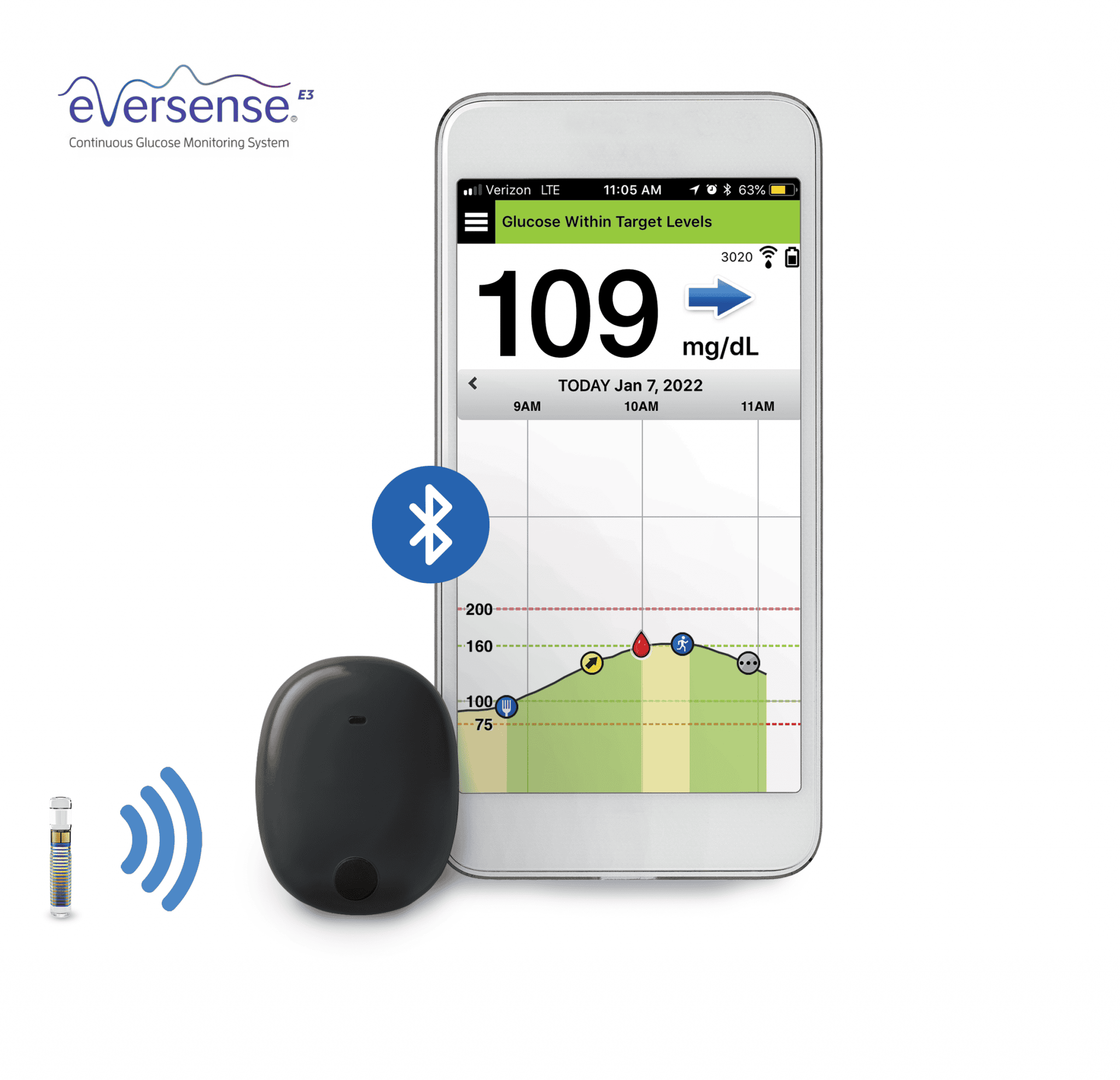
- an external, rechargeable transmitter worn on the skin above the implanted sensor;
- a dedicated mobile application that displays glucose values, trends, and alerts;
- a system architecture designed for extended use over several months.
Eversense E3 measures glucose concentration in the interstitial fluid, the extracellular environment into which glucose diffuses from the bloodstream before being taken up by cells. Measuring glucose at this level allows continuous tracking of glycemic evolution rather than isolated point values.
What Eversense E3 Measures
Like other CGM systems, Eversense E3 does not measure glucose directly from capillary blood. Instead, it measures glucose in the interstitial fluid. There is a direct physiological relationship between blood glucose and interstitial glucose, but also a natural time delay due to diffusion processes.
Under stable conditions, this delay is minimal. During rapid glucose changes—such as after carbohydrate-rich meals or during intense physical activity—the difference between capillary and interstitial glucose values may become more apparent.
This phenomenon is physiological and does not represent a measurement error. Eversense E3 is designed to provide information about trends, direction, and rate of change, rather than instantaneous capillary glucose values. Data interpretation must take this principle into account.
Who Eversense E3 Is Intended For
Eversense E3 is intended for individuals who use continuous glucose monitoring and require long-term glucose data without frequent external sensor applications. The system is designed for individual use and involves acceptance of a minor medical procedure for subcutaneous sensor implantation.
This guide is strictly informational and explanatory. It does not define medical indications, eligibility criteria, or therapeutic recommendations. Use of Eversense E3 must take place exclusively within an organized medical framework, with trained healthcare professionals responsible for implantation, follow-up, and sensor removal.
It is important to emphasize again that Eversense E3 is not currently officially available in Romania, which means that implantation procedures, structured follow-up, and technical support are not locally accessible in a standardized manner.
Components of the Eversense E3 System
The Eversense E3 system consists of several distinct components that work together to enable continuous glucose monitoring.
The central component is the implantable glucose sensor, a small device that is placed completely under the skin, usually in the upper arm. This sensor remains fully subcutaneous throughout its period of use and measures glucose in the interstitial fluid.
The second component is the external transmitter, which is worn on the skin directly above the implanted sensor. The transmitter receives data from the implantable sensor and sends them to the mobile application. It is detachable, rechargeable, and must be correctly positioned to ensure continuous data transmission.
The third component is the dedicated mobile application, installed on a compatible smartphone. The application displays glucose values, trend arrows, evolution graphs, and alerts.
Together, these components form the complete Eversense E3 system, which has a different architecture from conventional CGM sensors worn entirely on the surface of the skin.
What Needs to Be Done Before Sensor Implantation
Use of the Eversense E3 system requires a prior medical evaluation and a formal implantation procedure performed by trained healthcare personnel. Implantation is not a self-application process and cannot be performed independently by the user.
Before the procedure, the implantation site must be evaluated to identify a suitable area free of infection, inflammation, or local contraindications. The individual must also be informed about the implantation steps, post-procedure care, and correct use of the external transmitter.
It is recommended that the mobile application be installed and configured in advance, so that system activation can be completed after implantation.
How the Eversense E3 Sensor Is Implanted
Implantation of the Eversense E3 sensor is a minimally invasive medical procedure, performed in a clinic or medical office by trained professionals. The procedure involves making a small incision in the skin through which the sensor is inserted into the subcutaneous tissue.
After insertion, the incision is closed according to medical protocol and the area is dressed. The procedure is designed to be controlled and relatively quick. After local healing, the sensor remains completely under the skin, with no external components visible.
Following implantation, the external transmitter is placed on the skin above the implanted sensor to enable communication between the sensor and the mobile application.
System Activation After Implantation
After completion of the sensor implantation procedure, the Eversense E3 system must be activated in order to begin continuous glucose monitoring. Activation is performed through the dedicated mobile application and involves linking the implantable sensor, the external transmitter, and the user account.
The external transmitter is placed on the skin directly above the site where the sensor has been implanted. Correct positioning is essential for proper system function, as the transmitter is responsible for receiving data from the implantable sensor and transmitting them to the mobile application. The transmitter is detachable and rechargeable and must be worn according to instructions to ensure uninterrupted data transmission.
The mobile application guides the activation process, confirming when the transmitter has been correctly recognized and paired with the implantable sensor. Once this step is completed, the system is ready to initiate continuous glucose monitoring.
Passing through Romania and need a prescription for your chronic treatment?
Contact Dr. Petrache’s Virtual Clinic for any medical issue you encounter while in Romania. Send an email to: [email protected]
The User Account and Its Role
Use of the Eversense E3 system requires creation of a user account within the mobile application. The account is necessary for user identification, data storage, and access to glucose history.
Through the user account, glucose data collected by the implantable sensor are stored securely and can be reviewed over extended periods of time. The account enables continuity of data throughout the sensor’s lifespan and supports long-term analysis of glycemic patterns.
Account creation is performed by following the steps indicated in the application and is required for full system functionality.
The Initial Accommodation Period
After system activation, Eversense E3 enters an initial accommodation period during which the implantable sensor adapts to the local interstitial environment. This phase is required for stabilization of glucose measurements.
During the accommodation period, glucose values may show variability or require cautious interpretation. This is a normal physiological process and part of standard system operation. Data obtained during this phase should be interpreted with an emphasis on trends rather than isolated numerical values.
The duration of the accommodation period is specified within the application and follows the system’s defined protocol.
The First Days After Implantation
During the first days following implantation and activation, the Eversense E3 system begins delivering continuous glucose data on a regular basis. This phase is important for full sensor stabilization and for user familiarization with data presentation.
Differences may be observed between values displayed by the system and those obtained via capillary blood glucose measurements. These differences are explained by the physiological principles of interstitial glucose measurement and do not indicate system malfunction.
Proper interpretation during the first days focuses on observing glucose curves, direction of change, and emerging patterns, rather than relying solely on individual readings.
Data Displayed by the Eversense E3 Application
After completion of the initial accommodation period, the Eversense E3 mobile application begins displaying glucose values collected by the implantable sensor. Information is presented in a visual format designed to support continuous observation of glucose evolution over time, not only consultation of isolated values.
The application displays the current glucose value together with evolution graphs covering selectable time intervals. These visual representations allow observation of how glucose levels change throughout the day and night and how they relate to meals, physical activity, rest periods, illness, or other daily events.
In addition to the numerical value, the application indicates the direction of glucose change. This information shows whether glucose is rising, falling, or remaining relatively stable, providing essential context for correct interpretation of the displayed value at any given moment.
Glucose Graphs and Their Interpretation
The graphs generated by the Eversense E3 application represent glucose evolution as continuous curves. These curves are useful for identifying recurring glycemic patterns, such as postprandial increases, nocturnal decreases, or periods of increased variability.
Correct interpretation of glucose graphs involves analyzing the shape of the curve, the amplitude of changes, and the duration of these changes. A rapid increase followed by a sharp decline has a different meaning than a slow, sustained rise, even when peak glucose values are similar.
Graph-based visualization provides a comprehensive overview of glycemic behavior and supports understanding of the relationship between daily activities and glucose dynamics.
Alerts and Notifications – A Distinctive Feature of Eversense E3
The Eversense E3 system includes an alert system that operates both through the mobile application and through tactile vibration alerts generated by the external transmitter. This dual alert mechanism is a distinctive characteristic of the system.
The application allows configuration of alerts for low and high glucose values. Alert thresholds can be customized, and notifications are delivered when glucose levels approach or exceed the defined limits.
In addition to smartphone notifications, the external transmitter can generate on-body vibration alerts, allowing users to be informed of significant glucose events even when the phone is not nearby or notifications are muted. Different vibration patterns may correspond to different types of glucose events.
Alerts are informational in nature. They do not provide therapeutic instructions or indicate specific actions to be taken. Their role is to signal the presence of a value or trend that requires attention and contextual interpretation.
Data Storage and Retrospective Analysis
Glucose data collected by the Eversense E3 system are stored within the application and can be accessed later for retrospective analysis. The application allows review of glucose history over extended periods, providing insight into long-term glycemic patterns.
Retrospective analysis supports identification of medium- and long-term trends, such as the frequency and timing of hyperglycemic or hypoglycemic episodes and their distribution across different times of day.
These data contribute to a broader understanding of overall glycemic behavior and variability.
What Eversense E3 Does NOT Do
Eversense E3 is a continuous glucose monitoring system designed to collect and display glucose data, not to make medical decisions. Understanding the system’s limitations is essential for correct use and to avoid misinterpretation.
The system does not establish medical diagnoses. Displayed values and graphs cannot confirm or exclude diabetes, prediabetes, or other metabolic disorders. Interpretation must always take place within a clinical context and be correlated with medical history and laboratory testing.
Eversense E3 does not provide therapeutic recommendations. The mobile application does not calculate insulin doses, does not suggest treatment adjustments, and does not indicate specific actions to take based on displayed glucose values. The system is informational, not decision-making.
The system does not fully eliminate the need for capillary blood glucose measurements in all situations. Finger-stick confirmation may still be required when symptoms do not match sensor readings, during periods of rapid glucose change, or during certain phases of initial accommodation after implantation. This limitation is related to the physiological principle of interstitial glucose measurement.
Eversense E3 also does not interpret contextual factors. The system cannot determine why glucose levels rise or fall—whether due to food intake, stress, illness, or physical activity. Such interpretation requires contextual understanding and, when appropriate, medical guidance.
Functional Limitations of an Implantable CGM System
Although Eversense E3 offers the advantage of long-term monitoring without frequent external sensor replacements, it has functional limitations related to its implantable architecture.
Displayed glucose values reflect interstitial glucose rather than capillary blood glucose, which implies the presence of a physiological time lag during rapid glycemic changes. In addition, system operation depends on correct placement of the external transmitter over the implanted sensor and on maintaining adequate transmitter battery charge.
Temporary interruptions in data transmission, delays in value updates, or the need to reposition the transmitter may occur. These situations do not automatically indicate sensor malfunction and are part of normal operation of a complex technological system.
Understanding these limitations allows realistic interpretation of data and appropriate use of the information provided.
Tourist in Romania and in need of a prescription for your chronic treatment?
Contact Dr. Petrache’s Virtual Clinic for any medical issue you encounter while in Romania. Send an email to: [email protected]
Conclusion – User Guide Summary
Eversense E3 is a continuous glucose monitoring system with an implantable architecture, designed to provide long-term glucose data with continuous display, customizable alerts, and on-body vibration notifications via the external transmitter.
This guide has explained that Eversense E3 is not yet officially available in Romania, as well as how the system works, how implantation and activation are performed, how data are displayed, and how information should be interpreted within its functional limits.
Continuous glucose monitoring, including implantable systems, is an observational tool that supports understanding of glycemic behavior. Effective use of such a system requires adherence to instructions, contextual interpretation of data, and integration of information within an appropriate medical framework.
Follow us on:
- FaceBook: Diabetes & Nutrition;
- YouTube: Diabetes Facts.