How Do Homing Pigeons Find Their Way Home?

A Mystery That Has Fascinated People for More Than a Century
Few animals have inspired as much curiosity as homing pigeons. For centuries, people have observed an almost unbelievable ability in these birds: the capacity to return home from enormous distances, sometimes hundreds or even thousands of kilometers away, crossing unfamiliar regions and difficult weather conditions.
Before the advent of telephones, the internet, and modern communications, homing pigeons were among the fastest methods of transmitting information. They were used in wars, trade, and civilian activities. Some individuals became legendary because of their extraordinary performances.
Yet despite their long history of use, scientists have never been able to provide a complete explanation for how these birds find their way home.
Over the years, numerous theories have been proposed.
Some researchers suggested that pigeons use the position of the Sun. Others believed they relied on visual landmarks such as rivers, mountains, roads, or cities. There were also hypotheses that atmospheric odors played an important role in navigation.
However, one of the most fascinating theories has always involved the Earth’s magnetic field.
The idea that an animal could “sense” the planet’s magnetism sounds like something from science fiction. Nevertheless, numerous experiments conducted over the past decades have suggested that many migratory species use magnetic information, at least to some extent, for navigation.
The problem was that nobody had clearly identified the biological structure responsible for this phenomenon.
Until now.
The Discovery That Captured the Scientific World’s Attention
In May 2026, the journal Science published the results of a study that could radically change the way we understand animal navigation.
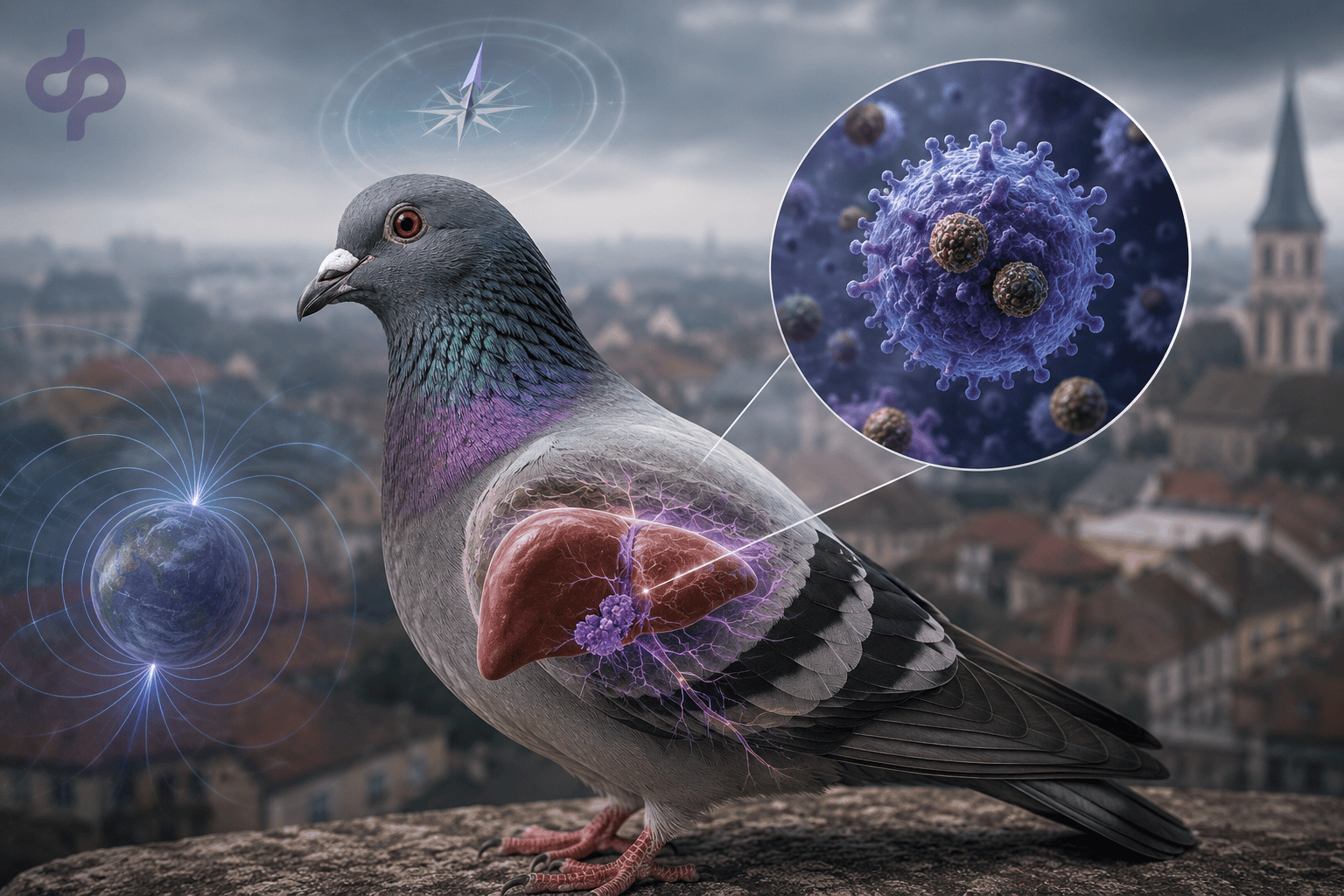
The research, led by German scientist Clivia Lisowski and conducted by an interdisciplinary team of biologists, physicists, and neuroscientists, proposes an unexpected explanation for the ability of homing pigeons to detect the Earth’s magnetic field.
The findings surprised even the scientific community.
Researchers did not identify magnetic receptors in the brain.
Nor in the eyes.
Nor in the beak.
Instead, they found them in an organ that almost nobody expected.
The liver.
More specifically, in specialized immune cells located within the liver.
The discovery is particularly intriguing because these cells are neither neurons nor part of any traditional sensory organ.
They are macrophages.
What Are Macrophages?
To understand the significance of this discovery, we first need to understand what macrophages are.
Macrophages are a type of immune cell.
Their name comes from Greek and literally means “large eaters.”
Their primary role is to identify and eliminate microorganisms, cellular debris, and foreign particles from the body.
They constantly patrol tissues and contribute to maintaining overall health.
Until now, most scientists believed their functions were limited to immune defense and tissue repair.
No one expected these cells to also serve as sophisticated biological sensors.
That is precisely why this discovery is so important.
It suggests that certain immune cells may perform far more complex functions than previously believed.
What Did Researchers Find in the Pigeons’ Livers?
While examining the tissues of homing pigeons, researchers identified a special group of macrophages containing unusually high amounts of iron.
These cells were not randomly distributed.
They were located in close proximity to nerve fibers.
Furthermore, their structure displayed very unusual physical properties.
The iron particles within them behaved as superparamagnetic materials.
To understand this concept, imagine microscopic particles capable of responding extremely sensitively to changes in magnetic fields.
These particles are not permanent magnets, but they react strongly when exposed to magnetic forces.
Their presence immediately attracted the attention of researchers.
If these cells can detect magnetic variations in the environment and are connected to the nervous system, they could represent the missing link scientists have been searching for over decades.
In other words, they may transform magnetic information into nerve signals that the brain can interpret.
Why Is the Earth’s Magnetic Field So Important?
For humans, the magnetic field is invisible.
We cannot see it.
We cannot hear it.
We cannot feel it.
Yet our planet is constantly surrounded by a vast magnetic field generated by the movement of molten metals within its core.
This field acts as a natural compass.
The needle of a traditional compass aligns itself with magnetic field lines.
Many animals appear to do something similar.
Over time, researchers have found evidence suggesting that migratory birds, sea turtles, salmon, and even some insects can perceive magnetic information.
Some species cross entire oceans without losing their way.
Others return with astonishing precision to the places where they were born.
These remarkable abilities have fueled the idea of a biological compass for decades.
The challenge was that nobody knew exactly where this compass was located or how it functioned.
The Experiment That Put the Theory to the Test
No matter how fascinating a microscopic discovery may be, the real challenge lies in demonstrating that it influences an animal’s behavior.
To do this, researchers designed a series of ingenious experiments.
They used homing pigeons trained to return home from approximately 20 kilometers away.
The birds were divided into groups.
In some of them, the iron-rich macrophages were experimentally removed or disrupted using carefully controlled methods.
The pigeons were then released under different weather conditions.
The results were striking.
On overcast days, birds lacking these macrophages lost their normal navigational ability.
They could no longer efficiently determine the direction home.
Meanwhile, pigeons in the control group continued to navigate successfully.
The difference between the two groups was clear enough to suggest that these cells play an essential role in magnetic orientation.
Even more interesting was what happened when the weather changed.
Why Did the Pigeons Recover Their Navigation on Sunny Days?
Perhaps the most elegant aspect of the entire study is that the results were not absolute.
The affected pigeons did not become permanently disoriented.
On sunny days, they largely regained their ability to navigate.
This suggests that birds use multiple navigation systems simultaneously.
When magnetic information is unavailable, they can rely on the position of the Sun and other visual landmarks.
In other words, nature did not rely on a single navigation system.
It created several backup mechanisms.
This strategy is highly effective from an evolutionary perspective and helps explain why homing pigeons are such extraordinary navigators.
A Discovery That Changes How We View the Immune System
Perhaps the most important conclusion of this study is not about pigeons.
It is about biology itself.
For decades, textbooks presented the nervous system, the immune system, and the sensory organs as distinct structures, each with clearly defined roles.
The brain processes information.
The eyes see.
The ears hear.
The immune system protects the body.
In reality, things are far more complex.
In recent years, research has shown that the immune system and nervous system communicate continuously. Immune cells influence behavior, memory, sleep, and even emotional states.
This new discovery takes that idea a step further.
If macrophages can function as magnetic receptors, then certain immune cells may not only protect the body but also participate directly in perceiving the surrounding environment.
This perspective is revolutionary.
It suggests that nature may have repurposed existing biological structures to create entirely new functions.
Rather than building a completely new sensory organ, evolution may have transformed specific immune cells into a magnetic detection system.
Could Similar Mechanisms Exist in Other Animals?
Homing pigeons are not the only animals believed to use magnetic information.
In fact, the list of species suspected of possessing this ability is impressive.
Migratory birds cross entire continents every year and return with remarkable precision to the same breeding grounds.
Sea turtles travel thousands of kilometers across oceans and return to the beaches where they hatched.
Salmon return to their native rivers after years spent in the open sea.
Certain bats, sharks, and insects also display behaviors consistent with magnetic navigation.
If the mechanism identified in pigeons proves valid, similar receptors may exist in other animals as well.
Of course, nature rarely uses a single solution for every species.
Some organisms may rely on magnetic particles.
Others may use light-dependent biochemical mechanisms.
It is entirely possible that evolution developed multiple solutions to the same challenge: navigating a highly complex world.
What Are Magnetic Particles in Living Organisms?
At first glance, it may seem strange that living organisms contain magnetic materials.
In reality, this phenomenon has been known for quite some time.
There are bacteria known as magnetotactic bacteria that produce microscopic crystals of magnetite.
These microorganisms essentially use a biological compass to orient themselves within their environment.
Their discovery provided one of the most fascinating demonstrations of how life can exploit the physical properties of matter.
Since then, researchers have searched for similar structures in many other organisms.
Iron-rich particles have been identified in various animal tissues, although their precise function often remained unclear.
The 2026 study provides one of the strongest experimental demonstrations to date that such structures can directly influence an animal’s navigational behavior.
Why Was This Mystery So Difficult to Solve?
One question frequently arises: if pigeons use the Earth’s magnetic field, why did scientists need more than a century to demonstrate it?
The answer is that magnetic perception is extremely difficult to study.
Unlike vision or hearing, there is no obvious stimulus we can directly observe.
We cannot ask a pigeon what it senses.
We cannot see magnetic fields.
Moreover, animals use multiple sources of information simultaneously.
A pigeon may orient itself using the Sun.
It may recognize geographical landmarks.
It may use odors carried by the wind.
It may use magnetic information.
When one of these systems is disrupted, the others can compensate.
It is precisely this redundancy that made the problem so difficult to solve experimentally.
Nature has built an exceptionally robust navigation system.
What Can This Discovery Teach Us About the Brain?
Another fascinating aspect concerns how the brain processes information.
If macrophages detect magnetic variations and transmit signals to nerve fibers, then the brain must somehow interpret those signals.
Yet no one fully understands how this occurs.
Pigeons do not see magnetic fields the way they see colors.
They do not hear them the way they hear sounds.
There may exist an entirely different form of perception unlike anything humans experience.
Understanding these mechanisms could provide important insights into the extraordinary flexibility of the nervous system and the brain’s ability to integrate radically different types of sensory information.
Implications for Neuroscience, Immunology, and Biophysics
Major scientific discoveries are valuable not only for what they explain but also for the new questions they raise.
This study opens several research directions simultaneously.
Neuroscientists will seek to understand how magnetic signals are processed in the brain.
Immunologists will investigate whether other immune cells may possess unexpected functions.
Biophysicists will study how iron-rich particles interact with the planet’s extremely weak magnetic fields.
Researchers in cognitive science will explore how these physical signals are transformed into complex navigational behaviors.
It is a perfect example of interdisciplinary science, where biology, physics, and neuroscience converge to explain a seemingly simple phenomenon.
Romania Also Studies Biomagnetism
Perhaps less known to the public is that biomagnetism is also an active field of research in Romania.
Various research institutions investigate processes such as iron biomineralization, magnetotactic bacteria, and interactions between magnetic particles and biological structures.
Among the centers involved in such research are the Institute of Biology of the Romanian Academy, the National Institute for Research and Development of Materials Physics in Măgurele, and the Interdisciplinary Research Institute in Bio-Nano-Sciences at Babeș-Bolyai University in Cluj-Napoca.
Although these projects are not focused exclusively on pigeons, they contribute to understanding fundamental phenomena with important implications for biology and medicine.
Nature Is More Sophisticated Than We Imagine
Every time we think we understand how living systems work, a new discovery forces us to reconsider our assumptions.
The idea that an immune cell could function as part of a biological compass would have seemed absurd to many scientists only a few years ago.
Today, it is supported by one of the world’s most prestigious scientific journals.
Of course, these findings will need to be independently replicated and confirmed. That is how science works.
Yet even if some details are revised in the future, the study already represents a major step forward in understanding animal navigation.
Perhaps the most important lesson of this discovery is one of humility.
Around us are seemingly ordinary organisms that we encounter every day in parks and city squares.
Some of them possess navigational abilities that even our most sophisticated technologies cannot yet fully replicate.
Homing pigeons remind us that nature continues to conceal extraordinary mechanisms and that some of the most remarkable discoveries may be hiding in plain sight, waiting to be uncovered.