I Ate a Pretzel Today. How Bad Can It Really Be?
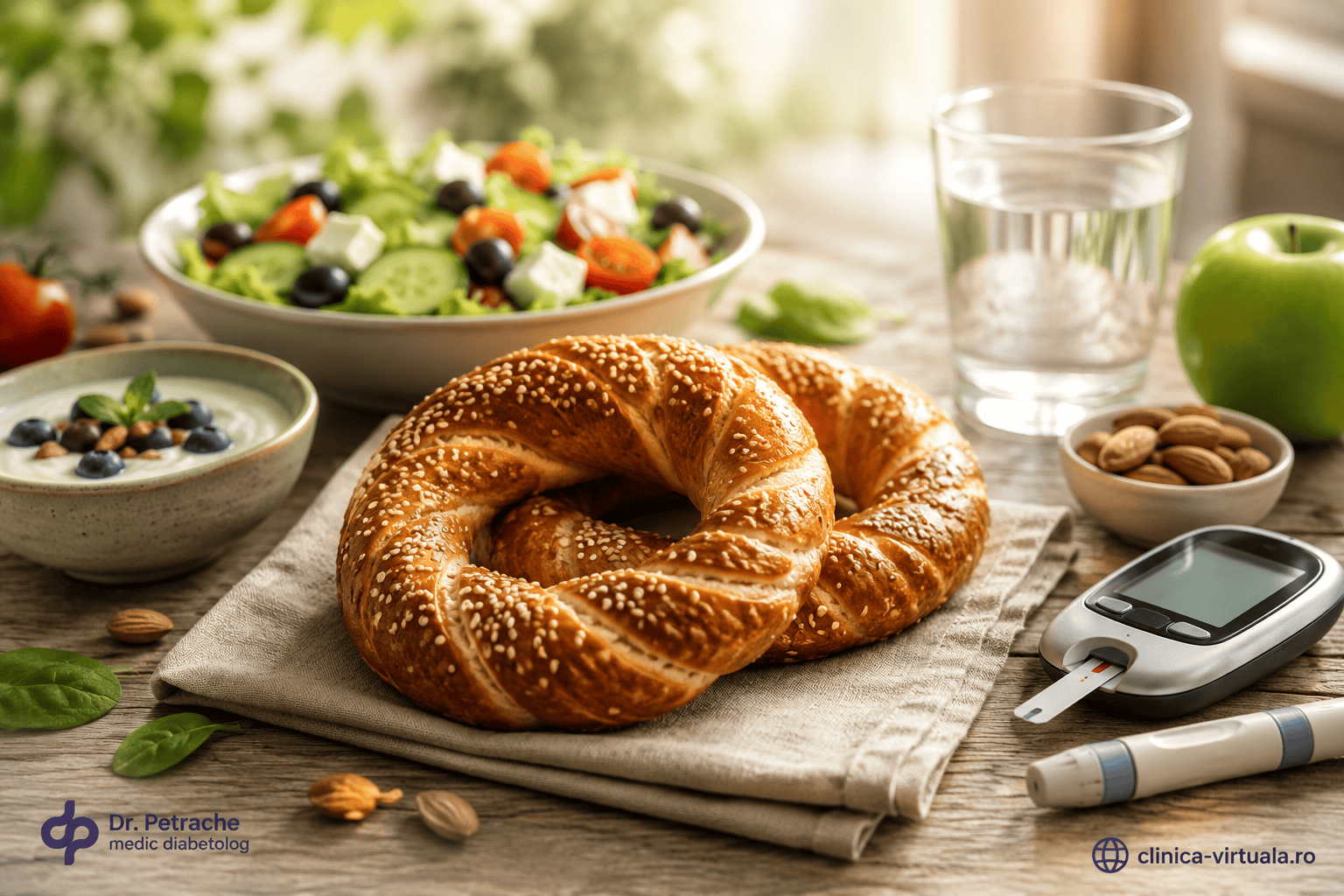

Why Does a Simple Pretzel Cause So Much Guilt?
It happens all the time.
You start a diet.
You decide to eat healthier.
Maybe you’re trying to lose weight, or perhaps you have diabetes and want better blood sugar control.
Then, on a busy morning, you grab a pretzel.
You eat it in a few minutes.
And immediately the question appears:
“Did I ruin everything?”
For some people, the question is followed by guilt.
For others, by panic.
Some decide that since they already “failed,” nothing matters anymore, and they continue eating poorly for the rest of the day.
In reality, a pretzel is nowhere near as important as we often think.
The problem is almost never the pretzel itself.
The problem is the context.
Tourist in Romania and in need of a prescription for your chronic treatment?
Contact Dr. Petrache’s Virtual Clinic for any medical issue you encounter while in Romania. Send an email to: clinica@diabet-si-nutritie.ro
What Does a Pretzel Actually Contain?
If we look at it objectively, a typical pretzel is mainly made of:
- white flour;
- water;
- yeast;
- salt.
Sometimes it also contains sugar, fats, or various toppings.
Nutritionally speaking, a pretzel is primarily a source of carbohydrates.
It does not contain significant amounts of protein.
It does not provide much fiber.
It offers relatively few vitamins and minerals compared to other foods.
In other words, it is a fairly simple food.
It is not poison.
But it is not a superfood either.
What Happens After You Eat It?
After consumption, the starch in the flour is broken down into glucose.
That glucose enters the bloodstream and raises blood sugar levels.
In people without diabetes, the pancreas releases insulin and blood sugar returns to normal.
In people with diabetes, the response may be different.
Blood sugar may rise higher and remain elevated longer.
This is one reason why pretzels are not considered the ideal choice for blood glucose control.
However, there is an important nuance.
The blood sugar response also depends on:
- the size of the pretzel;
- what you ate beforehand;
- what you eat it with;
- your level of physical activity;
- your insulin sensitivity.
There is no universal answer.
Is a Pretzel Worse Than Bread?
Many people assume it is.
In reality, the differences are often much smaller than they imagine.
A pretzel and a few slices of white bread can provide similar amounts of carbohydrates.
The issue is that a pretzel is extremely easy to eat.
- It is fast.
- It is convenient.
- It requires no preparation.
- It does not create much fullness.
As a result, many people consume it without realizing how much they have eaten.
Not because it is “toxic,” but because it is convenient.
What About the Glycemic Index?
Pretzels generally have a relatively high glycemic index.
This means blood sugar may rise fairly quickly after consumption.
However, glycemic index is not the only thing that matters.
Quantity matters too.
A food with a high glycemic index eaten in a small amount may have less impact than a food with a moderate glycemic index eaten in excess.
That is why modern nutrition and diabetes care focus more on the actual blood sugar response than on simplistic classifications.
What If You Have Diabetes?
If you have diabetes and you ate a pretzel, the first thing to do is not panic.
A single pretzel does not cause complications.
- It does not cause blindness.
- It does not cause kidney failure.
- It does not cause neuropathy.
Diabetes complications develop after repeated and prolonged exposure to elevated blood sugar levels.
One isolated episode does not significantly change the course of the disease.
On the other hand, unnecessary stress and guilt can turn a small dietary deviation into an entire day of unhealthy eating.
Foreigner In Romania and in need of a prescription for your chronic treatment?
Contact Dr. Petrache’s Virtual Clinic for any medical issue you encounter while in Romania. Send an email to: clinica@diabet-si-nutritie.ro
When Does a Pretzel Become a Problem?
Usually not when it is eaten occasionally.
The problem appears when it becomes a habit.
For example:
- a pretzel for breakfast;
- a pretzel between meals;
- a pretzel on the way to work;
- a pretzel whenever hunger strikes;
- a pretzel because nothing else is available.
In this situation, the intake of refined carbohydrates increases substantially.
At the same time, protein, fiber, and micronutrient intake remain low.
The occasional pretzel is not the problem.
The repeated habit is what matters.
It Also Matters What You Eat It With
A pretzel eaten alone is not the same as a pretzel eaten alongside:
- Greek yogurt;
- cheese;
- eggs;
- lean meat;
- vegetables.
Protein and fiber can slow digestion and reduce the magnitude of the blood sugar rise.
This is one reason mixed meals are often preferable to consuming carbohydrates on their own.
In practice, context can significantly influence the metabolic response.
What If You Are Trying to Lose Weight?
Again, the answer is less dramatic than many people expect.
You do not gain weight because of a single pretzel.
Weight gain occurs when a calorie surplus persists for days, weeks, and months.
One food does not determine the success or failure of a weight-loss program.
The problem arises when a small dietary slip is treated as a catastrophe.
Many people think like this:
“I ate the pretzel, so my diet is ruined.”
Then come:
- pizza;
- cakes;
- fast food;
- extra snacks.
In reality, the pretzel may represent only a few hundred calories.
Abandoning your entire eating plan because of it can add thousands more.
Why Nutrition Should Not Be Viewed in Black and White
The human body does not operate according to moral rules.
There are no “good” foods and “bad” foods.
There are more nutritious foods and less nutritious foods.
There are foods that promote satiety and foods that do so less effectively.
There are foods that raise blood sugar more and foods that raise it less.
But very rarely does a single food determine your health.
What matters is your overall dietary pattern.
What Should You Do After Eating a Pretzel?
Probably the opposite of what many people do.
- Do not skip meals.
- Do not punish yourself.
- Do not exercise excessively just to “burn off” the pretzel.
- Do not panic.
Simply continue your day.
- Eat your next meal in a balanced way.
- Stay hydrated.
- Be physically active if that is already part of your routine.
And move on.
Passing through Romania and need a prescription for your chronic treatment?
Contact Dr. Petrache’s Virtual Clinic for any medical issue you encounter while in Romania. Send an email to: clinica@diabet-si-nutritie.ro
The Final Verdict
If you ate a pretzel today, the good news is that nothing dramatic probably happened.
- You did not ruin your diet.
- You did not damage your health.
- You did not erase all the progress you have made so far.
A pretzel is simply a food.
Neither a hero.
Nor a villain.
What truly matters is what you eat on most days of the year, not on one rushed morning.
Sometimes the healthiest decision is not striving for perfection.
It is understanding that health is built through hundreds and thousands of choices repeated over time, and that a single pretzel rarely changes the story.
Follow us on:
- FaceBook: Diabetes & Nutrition;
- YouTube: Diabetes Facts.