Where you should NOT place your glucose sensor
Continuous glucose monitors are among the most valuable tools available today for understanding metabolism. They provide continuous data, trends, and a much clearer picture of how your body reacts to food, stress, and physical activity. However, there is one detail that can significantly affect the quality of the data you get: where you place the sensor.
Many people assume that a sensor will work the same no matter where it is applied. In reality, choosing the right location can make the difference between stable, reliable readings and confusing or misleading values. Just as important as knowing where to place it is understanding where it should be avoided.

Why placement matters
A glucose sensor measures glucose in the interstitial fluid, and this fluid is not distributed uniformly throughout the body. Blood flow, skin thickness, the amount of subcutaneous tissue, and local pressure all influence the accuracy of the readings.
In addition, the sensor stays attached to the skin for several days. If it is placed in an unsuitable area, not only can the readings be affected, but the risk of detachment, irritation, or discomfort also increases.
Foreigner In Romania and in need of a prescription for your chronic treatment?
Contact Dr. Petrache’s Virtual Clinic for any medical issue you encounter while in Romania. Send an email to: clinica@diabet-si-nutritie.ro
Areas where you should NOT place the sensor
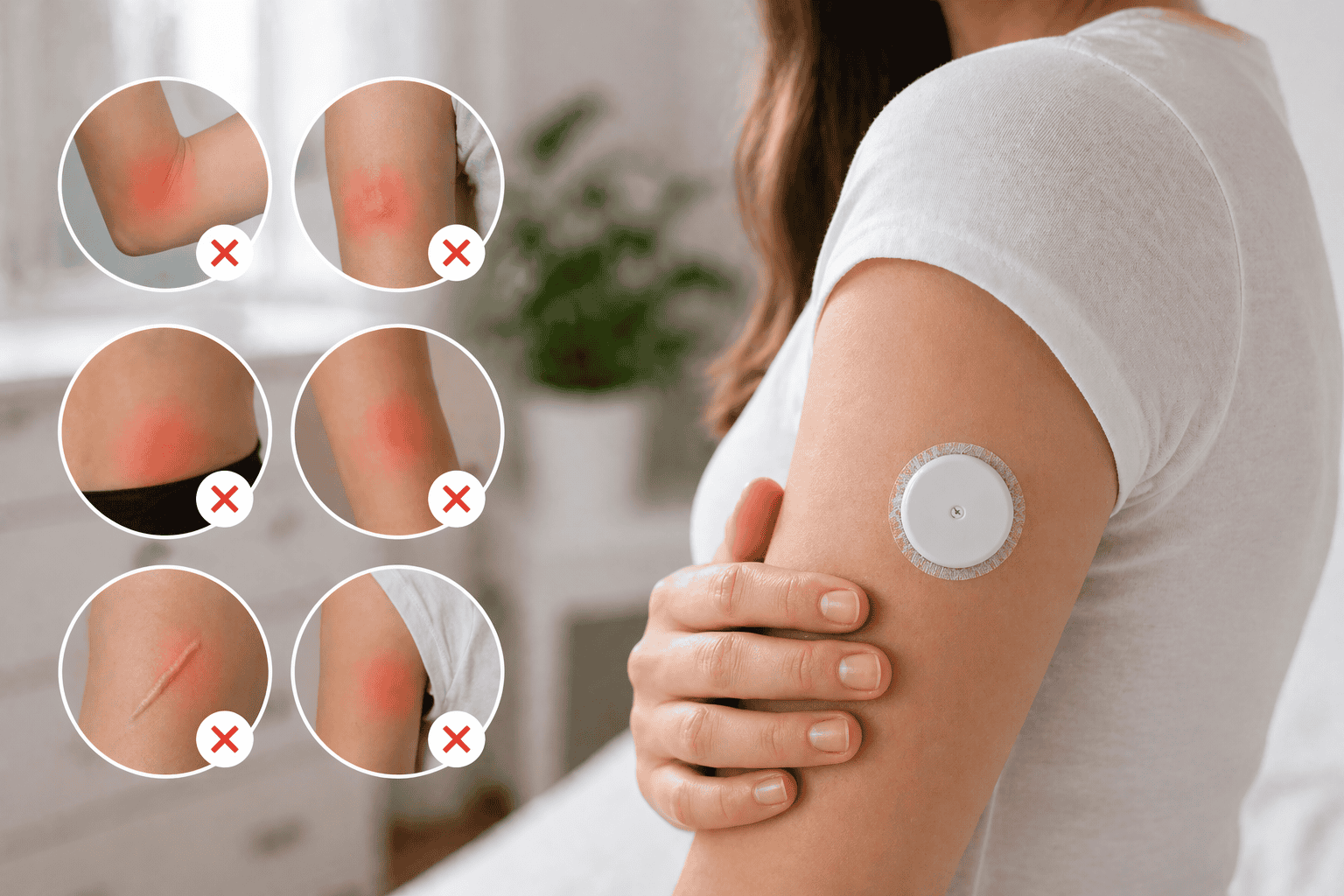
One of the most common mistakes is placing the sensor in areas exposed to frequent pressure. For example, if you choose a spot that you usually lie on while sleeping, it is very likely that false readings will occur, especially at night. These so-called “low glucose” episodes are not real, but the result of local compression, which temporarily alters the flow of interstitial fluid.
You should also avoid highly mobile areas. Joints or regions where the skin constantly stretches and contracts can affect the stability of the sensor. Repeated movement can lead to partial detachment or minor local trauma, both of which can interfere with readings.
Another problematic area is where the tissue is very thin or has very little subcutaneous fat. In such locations, the sensor may sit too close to structures that do not accurately reflect glucose levels in the interstitial fluid. This can result in more variable readings or discomfort.
Tourist in Romania and in need of a prescription for your chronic treatment?
Contact Dr. Petrache’s Virtual Clinic for any medical issue you encounter while in Romania. Send an email to: clinica@diabet-si-nutritie.ro
On the other hand, areas with very thick adipose tissue are not ideal either. Glucose diffusion may be slower, increasing the delay between actual changes and the values displayed. While the sensor will still function, interpreting the data becomes more difficult.
Special attention should be given to irritated or damaged skin. Applying a sensor on inflamed areas, lesions, or scars can lead to unpredictable readings and may worsen local skin issues. Adhesion is also less reliable in these conditions.
Another often overlooked factor is proximity to areas exposed to constant friction. Straps, waistbands, or tight clothing can repeatedly rub against the sensor, increasing the risk of early detachment and interrupting data collection.
What happens if you choose the wrong location
When the sensor is placed in an unsuitable area, the signs usually appear quickly. Readings may become unstable, there may be large discrepancies compared to other measurement methods, or you may notice unexplained episodes of low or high glucose.
In some cases, the issue is not immediately obvious. You might feel that your body is reacting unpredictably, when in fact the sensor is simply providing distorted information due to poor placement.
Besides accuracy, discomfort can also become a problem. A poorly placed sensor may feel bothersome during movement, sleep, or daily activities. This often leads to reduced long-term adherence.
Passing through Romania and need a prescription for your chronic treatment?
Contact Dr. Petrache’s Virtual Clinic for any medical issue you encounter while in Romania. Send an email to: clinica@diabet-si-nutritie.ro
How to choose the right location
Choosing the right spot is about balance. Ideally, it should be an area with sufficient subcutaneous tissue, minimal movement, no constant pressure, and limited friction.
That is why manufacturer-recommended sites, such as the back of the upper arm or the abdomen (depending on the sensor), are not chosen randomly. These areas generally provide the most stable conditions for measurement.
Even within these areas, it is helpful to rotate placement sites. Reapplying the sensor in exactly the same spot repeatedly can lead to irritation or local tissue changes over time.
Conclusion
Where you place your glucose sensor is not a minor detail—it is a key factor in the quality of the data you receive. Avoiding areas with pressure, excessive movement, or unsuitable tissue structure can make the difference between reliable readings and misleading information.
A glucose sensor is a powerful tool, but it only works properly when used under the right conditions. Sometimes, a simple change in placement can completely transform your experience and your confidence in the data you rely on every day.
Follow us on:
- FaceBook: Diabetes & Nutrition;
- YouTube: Diabetes Facts.