Celtic Salt – A Healthier Choice or Just Clever Marketing?
In recent years, Celtic salt has become one of the most talked-about products in the wellness industry. Social media is filled with claims that it hydrates better than regular water, restores electrolytes, boosts adrenal function, improves energy levels, balances blood pressure, and is significantly healthier than ordinary table salt.
These claims sound impressive—but are they supported by science?
As with many nutrition trends, the truth lies somewhere between fact and marketing. Celtic salt is neither a miracle food nor a worthless product. Understanding what it really is, how it differs from other types of salt, and what scientific evidence actually says can help us make informed dietary choices.

Tourist in Romania and in need of a prescription for your chronic treatment?
Contact Dr. Petrache’s Virtual Clinic for any medical issue you encounter while in Romania. Send an email to: clinica@diabet-si-nutritie.ro
What Is Celtic Salt?
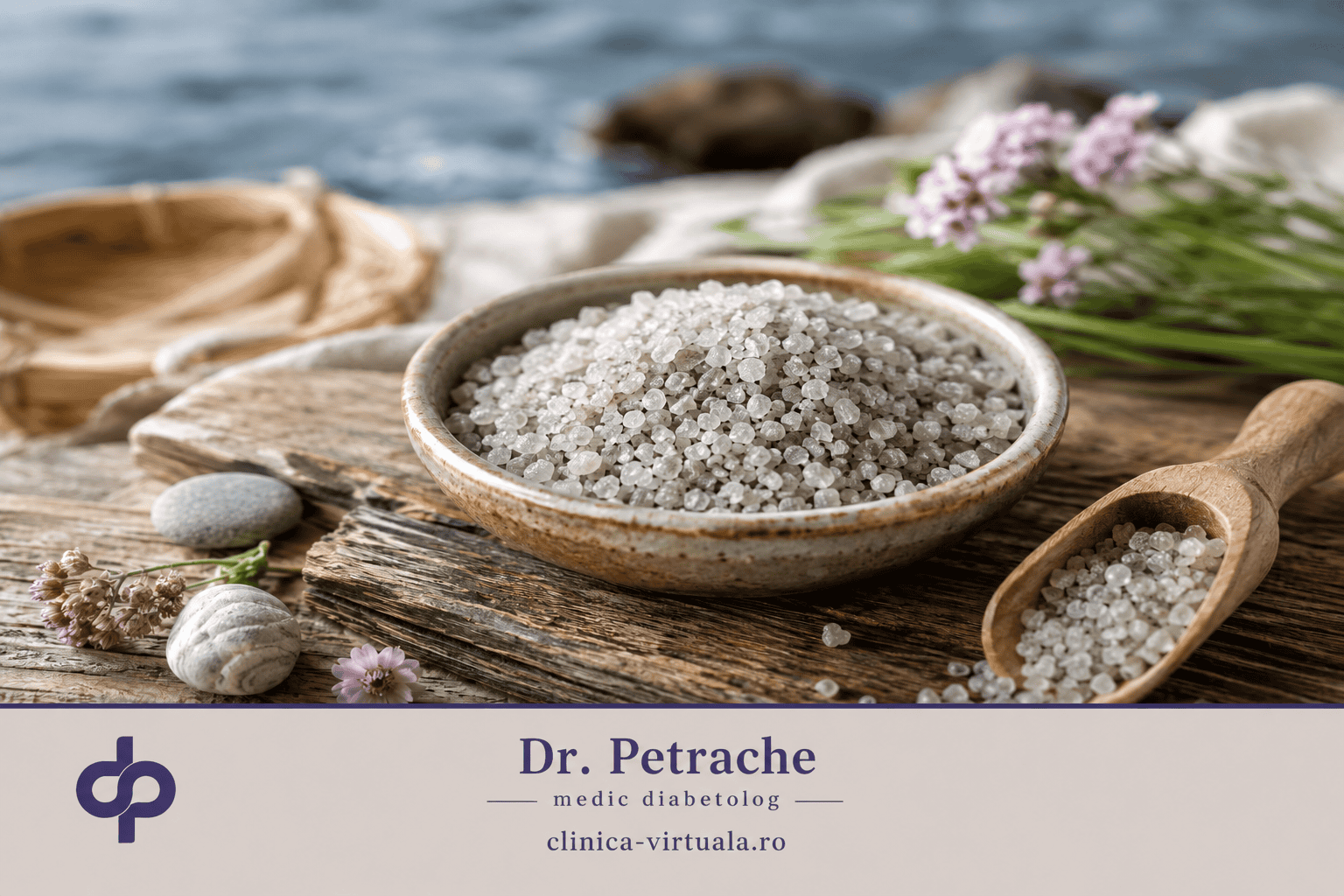
Celtic salt, often marketed as Celtic Sea Salt, is an unrefined sea salt harvested using traditional methods, primarily along the coast of Brittany, France.
Its name comes from the historical Celtic regions where it is produced rather than from any ancient recipe or unique biological property. Despite the marketing, there is no evidence that Celtic salt possesses special healing powers because of its origin.
Unlike refined table salt, Celtic salt:
- is minimally processed;
- retains part of its natural mineral content;
- has a distinctive grey color due to contact with clay during harvesting;
- contains more moisture;
- has larger crystals and a more complex flavor.
These characteristics make it attractive for culinary use, but they do not automatically translate into health benefits.
How Is It Produced?
The production process has remained largely unchanged for centuries.
Seawater flows through a series of shallow evaporation ponds where sunlight and wind gradually evaporate the water. Salt crystals are then harvested manually using traditional wooden tools.
The characteristic grey color comes from the clay lining the salt ponds, while the higher moisture content gives the crystals their distinctive texture.
In contrast, refined table salt is extracted from underground deposits or seawater and processed until it consists almost entirely of sodium chloride.
What Does Celtic Salt Contain?
Chemically speaking, Celtic salt is still primarily sodium chloride (NaCl).
Depending on the producer, approximately 94–98% of its composition is sodium chloride.
The remaining percentage consists of trace minerals, including:
- magnesium;
- calcium;
- potassium;
- iron;
- zinc;
- manganese;
- phosphorus;
- sulfur.
These trace minerals are often highlighted in marketing campaigns as evidence that Celtic salt is nutritionally superior.
However, the key question is whether these minerals are present in meaningful amounts.
Does Celtic Salt Provide Significant Minerals?
The answer is no.
Although Celtic salt contains more minerals than refined table salt, the quantities are extremely small.
A typical daily serving of salt provides only a few milligrams of magnesium or potassium.
For comparison:
- a handful of almonds contains more than 70 mg of magnesium;
- 100 grams of spinach provides around 80 mg of magnesium;
- one banana contains over 350 mg of potassium;
- one baked potato provides approximately 900 mg of potassium.
Obtaining meaningful amounts of these minerals from Celtic salt would require consuming dangerously large quantities of salt—far exceeding recommended sodium intake.
Therefore, while the minerals are present, they contribute very little to overall nutrition.
Foreigner In Romania and in need of a prescription for your chronic treatment?
Contact Dr. Petrache’s Virtual Clinic for any medical issue you encounter while in Romania. Send an email to: clinica@diabet-si-nutritie.ro
Is Celtic Salt Healthier Than Table Salt?
The answer depends on how we define „healthier.”
From a culinary perspective
Many chefs and food enthusiasts prefer Celtic salt because of its:
- richer flavor;
- pleasant texture;
- crunchy crystals;
- natural appearance.
These are genuine advantages for cooking and finishing dishes.
From a nutritional perspective
The differences are minimal.
The human body does not distinguish between sodium ions obtained from:
- Celtic salt;
- table salt;
- Himalayan pink salt;
- sea salt.
Sodium remains sodium regardless of its source.
Does Celtic Salt Lower Blood Pressure?
No scientific evidence suggests that Celtic salt affects blood pressure differently from regular salt.
Blood pressure depends primarily on:
- total sodium intake;
- individual salt sensitivity;
- potassium intake;
- body weight;
- physical activity;
- kidney function;
- genetic factors.
Changing the type of salt without reducing sodium intake does not significantly influence these mechanisms.
Two people consuming identical amounts of sodium—one from Celtic salt and the other from refined salt—would be expected to experience essentially the same physiological effects.
Does Celtic Salt Contain Less Sodium?
This claim is technically—but only slightly—true.
Because Celtic salt contains moisture and trace minerals, the percentage of sodium by weight may be marginally lower than that of refined table salt.
However, the difference is too small to have meaningful clinical significance.
It certainly does not justify consuming larger amounts of salt.
What Does „Unrefined” Really Mean?
Refining removes impurities and many naturally occurring trace minerals.
However, this does not make refined salt unhealthy.
Its primary ingredient—sodium chloride—remains unchanged.
In fact, refining offers several advantages:
- consistent composition;
- removal of unwanted contaminants;
- the addition of iodine.
The last point is particularly important from a public health perspective.
The Importance of Iodine
One of the most important facts often overlooked in social media discussions is that most Celtic salt is not iodized.
In many countries, iodized salt has played a crucial role in preventing iodine deficiency disorders.
Iodine is essential for producing thyroid hormones.
Insufficient iodine intake may lead to:
- goiter;
- hypothyroidism;
- impaired cognitive development in children;
- pregnancy complications;
- neurological problems in the developing fetus.
Individuals who replace iodized salt entirely with non-iodized alternatives should ensure they obtain sufficient iodine from other dietary sources such as seafood, dairy products, eggs, or physician-recommended supplements.
Passing through Romania and need a prescription for your chronic treatment?
Contact Dr. Petrache’s Virtual Clinic for any medical issue you encounter while in Romania. Send an email to: clinica@diabet-si-nutritie.ro
Does Celtic Salt Hydrate Better?
This is one of the most widespread myths on social media.
Recipes combining water, lemon juice, and Celtic salt are often promoted as „natural electrolyte drinks.”
In reality, plain water provides excellent hydration for healthy individuals.
Electrolyte replacement becomes important mainly during:
- prolonged intense exercise;
- heavy sweating;
- diarrhea;
- vomiting;
- extreme heat exposure.
Medical oral rehydration solutions are carefully formulated with precise amounts of sodium, glucose, and potassium.
Simply adding Celtic salt to water does not reproduce these scientifically designed electrolyte formulas.
Does It Support the Adrenal Glands?
No.
There is no scientific evidence showing that Celtic salt:
- „heals the adrenal glands”;
- treats adrenal fatigue;
- increases cortisol production.
Moreover, „adrenal fatigue” is not recognized as a legitimate medical diagnosis by major endocrinology societies.
True adrenal insufficiency is a serious endocrine disease requiring hormone replacement therapy—not a specific type of salt.
Does It Prevent Muscle Cramps?
There is no evidence that Celtic salt is superior to other sodium sources for preventing muscle cramps.
Muscle cramps can result from multiple factors, including:
- muscle fatigue;
- dehydration;
- magnesium deficiency;
- potassium deficiency;
- calcium deficiency;
- neurological disorders;
- certain medications.
Attributing every muscle cramp to sodium deficiency is an oversimplification.
Does Celtic Salt Detoxify the Body?
No.
The human body already possesses highly efficient detoxification systems involving:
- the liver;
- the kidneys;
- the lungs;
- the gastrointestinal tract;
- the skin.
No scientific studies have shown that Celtic salt enhances these natural detoxification processes.
Foreigner In Romania and in need of a prescription for your chronic treatment?
Contact Dr. Petrache’s Virtual Clinic for any medical issue you encounter while in Romania. Send an email to: clinica@diabet-si-nutritie.ro
Does It Alkalize the Body?
Another popular misconception.
Blood pH is tightly regulated within a very narrow range through complex physiological mechanisms.
Consuming Celtic salt does not alter the body’s acid-base balance in healthy individuals.
Are There Any Risks?
Yes.
Like every other type of salt, excessive intake may contribute to:
- hypertension;
- fluid retention;
- worsening heart failure;
- progression of chronic kidney disease;
- increased cardiovascular risk in salt-sensitive individuals.
Natural does not mean harmless.
Can Celtic Salt Contain Contaminants?
Because it is harvested from seawater, Celtic salt may contain trace amounts of:
- heavy metals;
- microplastics;
- environmental contaminants.
Current evidence suggests that commercially available products generally contain these substances at levels considered safe under existing regulations.
Nevertheless, the assumption that natural salt is completely pure is inaccurate.
Comparing Different Types of Salt
Table Salt
Advantages
- inexpensive;
- iodized;
- consistent composition.
Disadvantages
- less complex flavor.
Celtic Salt
Advantages
- pleasant texture;
- appreciated flavor;
- minimally processed;
- contains trace minerals.
Disadvantages
- more expensive;
- usually not iodized;
- no proven medical advantages.
Himalayan Pink Salt
Advantages
- attractive appearance;
- contains trace minerals.
Disadvantages
- often marketed with exaggerated health claims;
- usually not iodized;
- no proven superiority over other salts.
How Much Salt Should We Consume?
The World Health Organization recommends consuming less than 5 grams of salt per day, approximately one level teaspoon.
Unfortunately, most adults consume between 8 and 12 grams daily, largely because of sodium hidden in processed foods such as:
- processed meats;
- cheese;
- bread;
- pastries;
- fast food;
- canned foods;
- snacks;
- industrial sauces.
Reducing processed food consumption has a far greater impact on health than simply switching from one type of salt to another.
Passing through Romania and need a prescription for your chronic treatment?
Contact Dr. Petrache’s Virtual Clinic for any medical issue you encounter while in Romania. Send an email to: clinica@diabet-si-nutritie.ro
Final Verdict
Celtic salt is neither a miracle cure nor a nutritional scam.
It offers culinary advantages thanks to its flavor, texture, and traditional production methods. However, current scientific evidence does not support claims that it improves hydration, treats adrenal fatigue, lowers blood pressure, detoxifies the body, boosts metabolism, or provides significant amounts of essential minerals.
From a medical standpoint, the body handles the sodium in Celtic salt exactly the same way it handles the sodium in ordinary table salt.
Perhaps the most important consideration is iodine. If you choose to use Celtic salt exclusively, ensure that your diet provides sufficient iodine through seafood, dairy products, eggs, or supplements when appropriate.
Ultimately, the most important factor is not the type of salt you choose, but how much sodium you consume overall.
A balanced diet rich in vegetables, fruits, legumes, whole grains, and minimally processed foods, combined with moderation in total salt intake, will have a far greater impact on long-term health than replacing ordinary table salt with a more expensive gourmet alternative.
In other words, if you enjoy the taste of Celtic salt, feel free to use it in moderation. But if you are buying it because you believe it has extraordinary healing properties, current scientific evidence suggests you are paying more for marketing than for measurable health benefits.
Follow us on:
- FaceBook: Diabetes & Nutrition;
- YouTube: Diabetes Facts.