Dexcom ONE – Good, but Outdated

In recent years, I have tested numerous technologies designed for glucose monitoring. As a diabetologist, I am very interested in the evolution of these devices because they can radically change the way patients manage their disease.
One of these technologies is the Dexcom ONE system, produced by Dexcom, a very well-known company in the field of continuous glucose monitoring.
Before writing these lines, I personally used this system in order to better understand how it works in real life, beyond brochures and commercial presentations.
What follows is not a technical analysis and not an official evaluation. It is simply my personal experience as a diabetologist.

First Contact with Dexcom ONE
When I started using Dexcom ONE, I was curious to see how much this technology could help in everyday life.
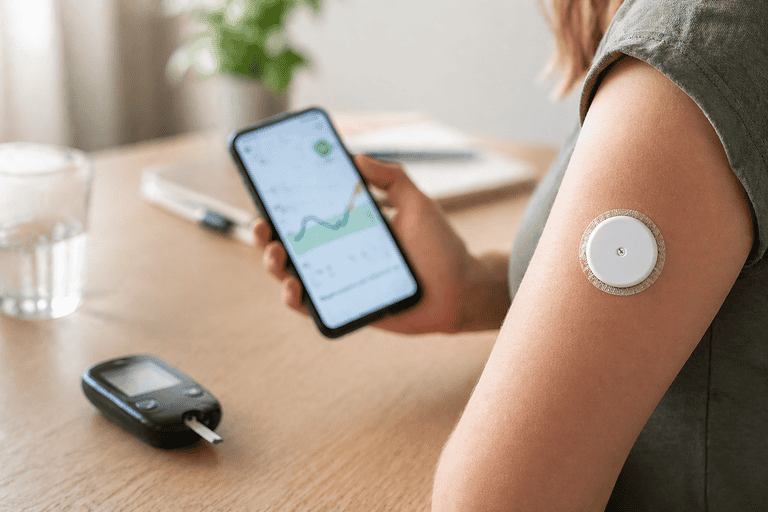
The concept is, without doubt, very attractive: a sensor applied to the skin that continuously transmits glucose values to the phone.
In reality, however, the sensor marketed as “small” is significantly larger and heavier compared to other sensors available on the market. The pressure on the skin is noticeable and you remain constantly aware that you are wearing it, unlike other systems that you almost forget about after a while.
For patients, the promise is seductive: fewer finger pricks and a continuous picture of glucose levels. However, it should be clearly stated that Dexcom is not the only system that provides this type of monitoring.
At a theoretical level, everything looks ideal. In practice, my experience was much more nuanced.
The adhesive is not of the best quality and tends to loosen before the 10-day period ends. In addition, in my case it caused an allergic reaction that took several days to heal after removing the sensor.
A 10-Day Duration – Too Short for Me
The first thing that caught my attention was the sensor’s lifespan.
Dexcom ONE is designed to function for about 10 days.
For me, honestly, this duration is too short.
To cover one month, you need approximately three sensors, and the cost of these three sensors becomes quite significant when compared to other products on the market.
There are continuous glucose monitoring systems that can be used for 14 or even 15 days. The difference of a few days may seem small at first glance, but it becomes very important when you use the system continuously.
If we make a simple calculation, 10 days means the sensor must be replaced roughly three times per month.
This frequency is not only inconvenient, but it also significantly increases the total cost of using the system.
For me, this represents a major drawback of Dexcom ONE.
The Cost – A Serious Investment
Another aspect that raised questions for me is the price.
Dexcom ONE is not an inexpensive device.
If you need to purchase about three sensors per month in order to use the system continuously, the total cost becomes quite high.
For someone who wants to use this technology long-term, the yearly expense can reach considerable amounts.
As a physician, I inevitably ask myself: is this technology truly accessible for most patients?
For some people, the answer is probably no.
This is especially relevant considering that there are alternative systems on the market whose monthly cost is almost equivalent to the price of a Dexcom ONE sensor used for just 10 days.
Differences Between the Sensor and the Glucometer
Another thing that surprised me during use was that, in certain situations, the values displayed by the sensor were not even close to those measured with a glucometer.
The differences sometimes reached as much as 50 mg/dL, which is difficult to accept in the monitoring of a patient with diabetes.
Considering the price of the device, the argument of superior quality becomes difficult to support when such discrepancies occur.
Of course, there is a physiological explanation for these differences. CGM sensors measure glucose in the interstitial fluid, not directly in the blood.
However, in my personal experience, there were moments when the differences were large enough to raise serious questions.
In such situations, the natural reflex is to verify the glucose value using a glucometer.
This means that, in practice, the system does not completely eliminate the need for traditional testing.
Moreover, after repeatedly noticing such discrepancies, I gradually lost confidence in the values displayed by the sensor and found myself checking with the glucometer almost every time the sensor sent an alert.
Many times, the values shown by the sensor were significantly different from the actual blood glucose values.
This type of error can become dangerous, because there are patients who may adjust their treatment based on these readings.
For this reason, I recommend caution to anyone who chooses to use this system.
Personally, after this experience, I cannot recommend it.
The First Hours After Applying the Sensor
Another aspect I noticed was the behavior of the sensor immediately after application.
During the first hours, or sometimes even during the first day, the readings may be unstable until the sensor begins to function within optimal parameters.
This can create a certain level of uncertainty for users, especially for those who rely heavily on the immediate accuracy of the readings.
My Experience with Distribution
Besides the experience with the device itself, I also had a very unpleasant experience related to the purchasing process and the communication with the company that distributes the product in Romania.
I will not mention names, because the purpose of this text is not to criticize specific individuals or companies.
However, the interaction I had was far from one of the most pleasant commercial experiences I have had. The responses I received seemed scripted, lacking flexibility, empathy, and even basic respect. Until my interaction with the Dexcom distributor in Romania, I believed that business relationships were based on respect for customers. Unfortunately, this experience proved otherwise.
Sometimes, the way customer relations are handled can influence the perception of a product almost as much as the product itself.
Technology Is Interesting, but Not Perfect
I do not deny that Dexcom ONE is a modern and interesting technology.
Continuous glucose monitoring is undoubtedly a major step forward in diabetology.
For many patients, these systems can bring real benefits.
However, my personal experience has shown that there are also aspects that deserve to be discussed openly:
- the relatively short sensor lifespan,
- the high cost of continuous use,
- the frequent differences compared with glucometer readings,
- and the very unpleasant distribution experience.
My Personal Conclusion
After using Dexcom ONE, my overall impression is that we are dealing with an interesting technology, but one that is not without compromises.
For me, the 10-day sensor lifespan is too short, and the cost of continuous use raises serious questions.
The differences between the sensor and the glucometer reminded me that, in diabetology, no technology can completely replace clinical judgment and traditional monitoring methods.
If I had to choose again, I personally would not choose Dexcom ONE, especially considering that there are many other sensors on the market that are both more accurate and more affordable.