hs-CRP – What Is It and Why Is It Important?
In recent years, more and more people have undergone advanced laboratory testing to assess their cardiovascular risk and noticed a parameter called hs-CRP (high-sensitivity C-reactive protein) on their blood test reports. While many patients are familiar with the standard C-reactive protein (CRP) test, the high-sensitivity version is different and provides extremely valuable information about cardiovascular health.
hs-CRP does not measure cholesterol, blood sugar, or blood pressure. Instead, it helps identify an often-overlooked risk factor: low-grade chronic inflammation, a process that contributes to the development of heart attacks, strokes, and atherosclerosis.

Tourist in Romania and in need of a prescription for your chronic treatment?
Contact Dr. Petrache’s Virtual Clinic for any medical issue you encounter while in Romania. Send an email to: clinica@diabet-si-nutritie.ro
What Is hs-CRP?
hs-CRP stands for high-sensitivity C-reactive protein, a protein produced by the liver in response to inflammation.
Standard CRP testing is commonly used to detect infections and significant inflammatory processes. In these situations, CRP levels may increase dramatically, sometimes reaching values dozens or even hundreds of times above normal.
The hs-CRP test uses a much more sensitive laboratory method capable of detecting very small increases in inflammation—levels that are not high enough to indicate an infection but may suggest the presence of persistent, low-grade chronic inflammation throughout the body.
This subtle inflammatory state is now considered one of the key mechanisms involved in the development of cardiovascular disease.
Why Is Inflammation Important?
For many years, atherosclerosis was thought to be solely a cholesterol-related problem.
Today, we know the process is much more complex.
Cholesterol deposits within the walls of arteries trigger a local inflammatory response. The body attempts to repair the damage, but over time this process contributes to the formation and destabilization of atherosclerotic plaques.
When a plaque ruptures, a blood clot may form and block blood flow, causing:
- Heart attack
- Stroke
- Peripheral arterial disease
Therefore, cardiovascular risk depends not only on cholesterol levels but also on the degree of inflammation associated with vascular damage.
What Information Does hs-CRP Provide?
hs-CRP is primarily used to assess cardiovascular risk.
Individuals with elevated hs-CRP levels have a higher risk of developing:
- Heart attack
- Stroke
- Peripheral arterial disease
- Cardiovascular death
Interestingly, some people have normal cholesterol levels but elevated hs-CRP values and may therefore have a higher cardiovascular risk than traditional tests alone would suggest.
For this reason, hs-CRP can complement information provided by:
- Total cholesterol
- LDL cholesterol
- HDL cholesterol
- Triglycerides
- Blood glucose
- Hemoglobin A1c
- Blood pressure measurements
What Are Normal hs-CRP Values?
The interpretation of hs-CRP differs from that of standard CRP.
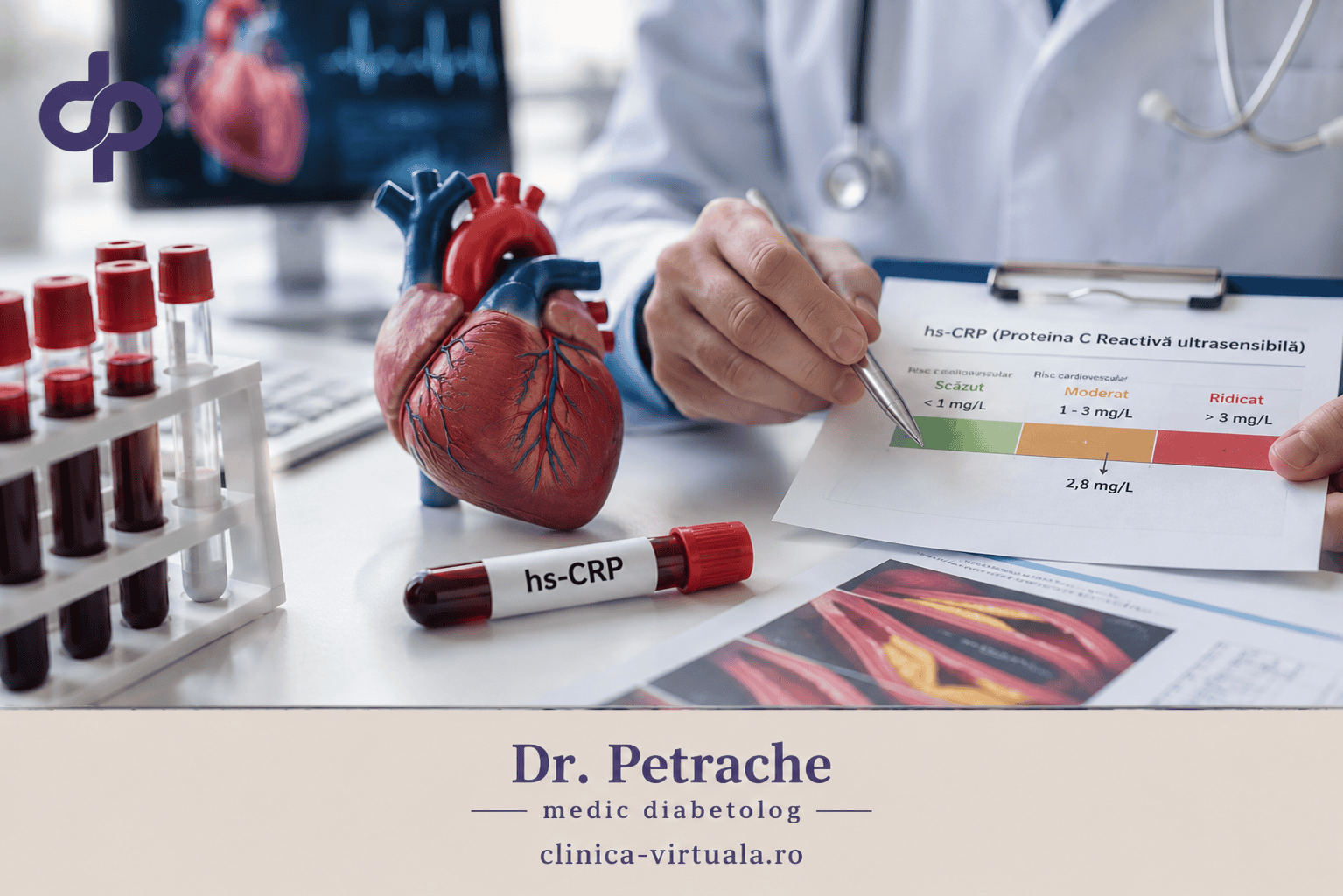
For cardiovascular risk assessment, the following categories are commonly used:
- Less than 1 mg/L – Low cardiovascular risk
- Between 1 and 3 mg/L – Moderate cardiovascular risk
- Greater than 3 mg/L – High cardiovascular risk
Values above 10 mg/L usually suggest an acute infection or inflammatory condition and generally require repeat testing after recovery.
Results should always be interpreted in the context of the patient’s overall clinical picture.
Who Should Consider This Test?
hs-CRP may be particularly useful for individuals with cardiovascular risk factors, including:
- People with diabetes
- Individuals with obesity
- Smokers
- Patients with hypertension
- People with elevated cholesterol levels
- Those with a family history of heart attack or stroke
- Sedentary individuals
The test may also be helpful when cardiovascular risk is difficult to estimate using traditional risk factors alone.
Foreigner In Romania and in need of a prescription for your chronic treatment?
Contact Dr. Petrache’s Virtual Clinic for any medical issue you encounter while in Romania. Send an email to: clinica@diabet-si-nutritie.ro
hs-CRP and Diabetes
For people living with diabetes, hs-CRP has special significance.
Diabetes is associated with a chronic low-grade inflammatory state. Elevated blood glucose levels damage blood vessels and stimulate inflammatory pathways that accelerate atherosclerosis.
Numerous studies have shown that patients with diabetes and elevated hs-CRP levels face a significantly higher cardiovascular risk than those with lower levels.
This is one reason why blood sugar control is not the only goal of diabetes management.
Equally important are:
- Weight management
- Blood pressure control
- Cholesterol management
- Reduction of chronic inflammation
hs-CRP and Obesity
Body fat is not simply a storage site for excess calories.
Today, adipose tissue is recognized as an active endocrine organ capable of producing numerous inflammatory substances.
People who are overweight or obese frequently have elevated hs-CRP levels.
The larger the waist circumference, the higher the inflammatory burden is likely to be.
The good news is that weight loss often leads to a significant reduction in hs-CRP levels.
This is one reason why even modest weight loss can improve cardiovascular health before major improvements in cholesterol levels are observed.
What Can Increase hs-CRP?
Several factors may contribute to elevated hs-CRP levels:
- Obesity
- Diabetes
- Smoking
- Physical inactivity
- Hypertension
- Chronic stress
- Autoimmune diseases
- Recent infections
- Chronic inflammatory disorders
- Sleep disturbances
- Obstructive sleep apnea
For this reason, hs-CRP should never be interpreted in isolation.
How Can hs-CRP Be Reduced?
Reducing chronic inflammation involves lifestyle modifications and, in some cases, medical treatment.
Weight Loss
Losing as little as 5–10% of body weight can significantly lower hs-CRP levels.
Regular Physical Activity
Consistent exercise reduces inflammation and improves vascular health.
Most guidelines recommend at least 150 minutes of moderate-intensity physical activity per week.
An Anti-Inflammatory Diet
A diet rich in:
- Vegetables
- Fruits
- Fish
- Olive oil
- Nuts and seeds
may help reduce chronic inflammation.
On the other hand, excessive consumption of:
- Ultra-processed foods
- Sugar-sweetened beverages
- Refined carbohydrates
- Trans fats
can promote inflammation.
Smoking Cessation
Smoking is one of the strongest contributors to vascular inflammation.
Management of Associated Conditions
Proper treatment of diabetes, hypertension, and dyslipidemia can indirectly reduce hs-CRP levels and improve cardiovascular health.
Can hs-CRP Predict a Heart Attack?
No single test can predict a heart attack with complete certainty.
However, hs-CRP provides valuable additional information regarding cardiovascular risk.
Several studies have shown that individuals with elevated hs-CRP levels experience cardiovascular events more frequently than those with lower levels.
For this reason, hs-CRP is included in several international guidelines as an additional marker for cardiovascular risk assessment.
Passing through Romania and need a prescription for your chronic treatment?
Contact Dr. Petrache’s Virtual Clinic for any medical issue you encounter while in Romania. Send an email to: clinica@diabet-si-nutritie.ro
Conclusions
hs-CRP is a simple yet highly valuable blood test that measures low-grade chronic inflammation within the body. Although it is not used to diagnose infections, it can provide important information about cardiovascular risk and vascular health.
For individuals with diabetes, obesity, hypertension, or elevated cholesterol levels, hs-CRP can serve as an additional piece of the puzzle when assessing cardiovascular risk.
An elevated hs-CRP result does not mean that a heart attack is inevitable. However, it may serve as a warning sign that the body is experiencing an inflammatory state that deserves attention and correction. In many cases, weight loss, regular physical activity, a balanced diet, and proper management of metabolic conditions can significantly lower hs-CRP levels and help protect cardiovascular health in the long term.
Follow us on:
- FaceBook: Diabetes & Nutrition;
- YouTube: Diabetes Facts.