Sprouts in diabetes

Sprouts in diabetes – which are the best and why they deserve a place in your daily diet
In recent years, sprouts have become increasingly present in nutritional recommendations and are often promoted as “superfoods.” Beyond marketing, the reality is that these early-stage plants are indeed nutritionally dense and can offer real benefits, especially in the context of diabetes.
If you have diabetes or are in the prediabetes range, you are probably wondering whether they are worth including, which ones are the most useful, and whether they can influence blood glucose. The answer is not a simple yes or no, but rather depends on the type of sprouts and how you integrate them into your daily diet.
Sprouts are not a treatment for diabetes, but they can become a valuable tool within a well-structured nutritional strategy, particularly through their effects on inflammation, oxidative stress, and insulin sensitivity.
Foreigner In Romania and in need of a prescription for your chronic treatment?
Contact Dr. Petrache’s Virtual Clinic for any medical issue you encounter while in Romania. Send an email to: clinica@diabet-si-nutritie.ro
What are sprouts and why are they so nutritionally concentrated
Sprouts are very young plants, harvested in the first days after germination. At this stage, the plant contains all the resources needed for growth, which translates into a high concentration of vitamins, minerals, and bioactive compounds.
In practical terms, they represent an “activated” form of food. Enzymes are more available, antioxidants are more concentrated, and nutrient absorption is often better compared to the mature form of the plant.
For people with diabetes, this is particularly relevant because chronic inflammation and oxidative stress play a major role in disease progression and in the development of complications.
How sprouts influence blood glucose
An important aspect is that most sprouts are low in carbohydrates and do not cause significant increases in blood glucose when consumed in normal amounts.
Their effect is not to “lower glucose” immediately like medication, but rather to improve the overall metabolic environment. By reducing inflammation and supporting insulin sensitivity, they can indirectly contribute to better glycemic control.
For this reason, sprouts should not be seen as a miracle solution, but as one piece of a larger puzzle that includes diet, physical activity, sleep, and medical treatment when necessary.
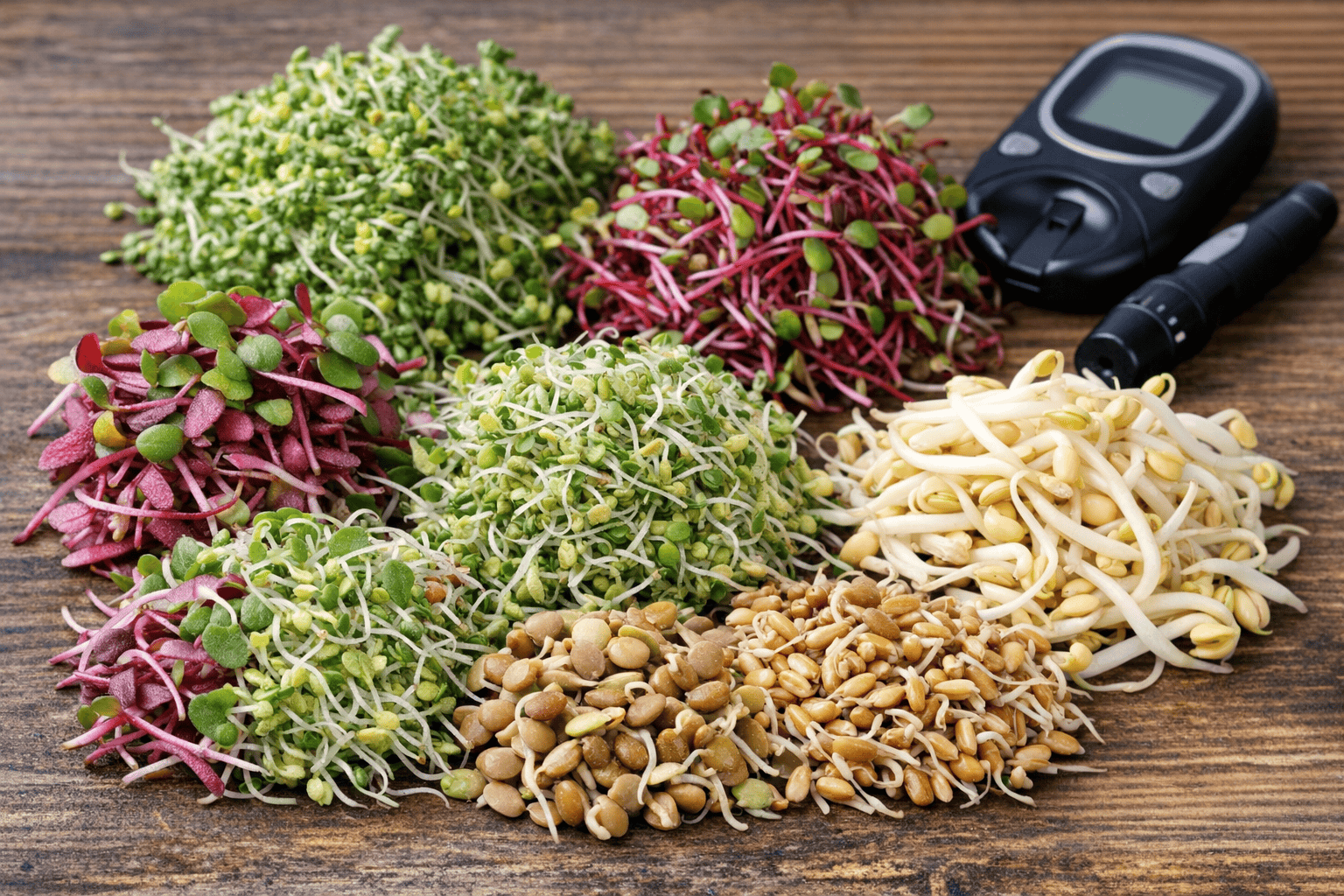
Broccoli sprouts – probably the most valuable in diabetes
Among all sprouts, broccoli sprouts are by far the most studied and the most promising in terms of metabolic impact.
Their key compound is sulforaphane, a powerful anti-inflammatory and antioxidant molecule. Interestingly, broccoli sprouts can contain dozens of times more sulforaphane than mature broccoli.
Clinical studies have associated sulforaphane with improved insulin sensitivity and reduced fasting glucose. There is also evidence suggesting a modest reduction in HbA1c, meaning the effect is not only short-term but also relevant over time.
Beyond metabolic effects, broccoli sprouts support vascular health and reduce inflammation, both essential in preventing diabetes complications.
Beet sprouts – vascular support and antioxidant protection
Beet sprouts do not have the same direct impact on blood glucose as broccoli sprouts, but they offer other important benefits.
They are rich in natural nitrates, which contribute to the production of nitric oxide, a molecule involved in blood vessel dilation. This can support circulation and may have a beneficial effect on blood pressure.
In addition, they contain specific antioxidants such as betalains, which help reduce oxidative stress. In diabetes, where blood vessels are often affected, this type of protection is particularly valuable.
In simple terms, if broccoli sprouts are “metabolic,” beet sprouts are more “vascular.”
Radish sprouts – detox support and mild metabolic benefits
Radish sprouts are known for their slightly spicy taste and for their content of sulfur compounds, similar but less concentrated than those found in broccoli.
These compounds support liver detoxification processes and have antioxidant effects. In diabetes, this can be useful by reducing oxidative stress and supporting liver metabolism, which plays a role in glucose regulation.
Their direct effect on blood glucose is modest, but they contribute to overall metabolic balance.
Passing through Romania and need a prescription for your chronic treatment?
Contact Dr. Petrache’s Virtual Clinic for any medical issue you encounter while in Romania. Send an email to: clinica@diabet-si-nutritie.ro
Alfalfa sprouts – gentle but useful for daily consumption
Alfalfa sprouts are among the easiest to tolerate and integrate into daily meals due to their mild taste.
They provide vitamins, minerals, and phytonutrients that support general health and may help reduce low-grade inflammation, commonly present in diabetes.
They do not have a direct effect on blood glucose, but they are ideal for daily use as part of a balanced diet.
Lentil or chickpea sprouts – protein support with attention to quantity
Lentil and chickpea sprouts offer an important advantage through their content of plant-based proteins and fiber.
They can contribute to satiety and help stabilize blood glucose when consumed in moderate amounts. However, compared to other sprouts, they contain more carbohydrates, which means they need to be integrated carefully into the diet.
For people with diabetes, the key is portion control, not complete avoidance.
Wheat sprouts – energy and micronutrients, but in moderation
Wheat sprouts are very rich in B vitamins, vitamin E, and minerals, making them a concentrated source of energy.
At the same time, they contain more carbohydrates than other sprouts, which makes them less suitable for large quantities in diabetes.
They can be included occasionally, in small portions, especially when combined with protein and healthy fats to prevent glycemic spikes.
Bean sprouts – a balance between fiber and carbohydrates
Bean sprouts are an interesting option, providing fiber, vitamins, and a moderate amount of protein.
They can support digestion and contribute to a more stable glycemic response due to their fiber content. However, as with lentil or chickpea sprouts, their carbohydrate content is higher, so intake should be adapted.
When used properly, they can be part of a balanced diabetes-friendly diet.
How to consume sprouts correctly to preserve their benefits
An important and often overlooked detail is how sprouts are consumed. Most of their active compounds are sensitive to heat.
For this reason, it is best to eat them raw. Cooking them can significantly reduce their benefits.
They can be added to salads, placed over eggs after cooking, included in sandwiches, or combined with simple foods such as avocado, yogurt, or cheese.
The quantity does not need to be large. A small handful per day is enough to obtain benefits without complicating your diet.
Are there risks or contraindications?
In general, sprouts are safe, but there are a few aspects to consider.
Because they are consumed raw, there is a microbiological risk if they are not properly grown or stored. It is important to buy them from reliable sources or prepare them at home under hygienic conditions.
Some people may experience digestive sensitivity, especially at the beginning. It is best to start with small amounts and increase gradually.
In the case of beet sprouts, the oxalate content may be an issue for individuals with kidney stones, so consumption should be moderate in these situations.
Tourist in Romania and in need of a prescription for your chronic treatment?
Contact Dr. Petrache’s Virtual Clinic for any medical issue you encounter while in Romania. Send an email to: clinica@diabet-si-nutritie.ro
Conclusion – are sprouts worth including if you have diabetes?
The answer is clearly yes, but with realistic expectations.
Sprouts do not replace treatment and are not a quick solution for lowering blood glucose. However, they can become a valuable ally in metabolic control, especially when integrated into a balanced lifestyle.
If you had to choose just one type, broccoli sprouts are the most valuable from a metabolic perspective. If you want additional vascular support, you can combine them with beet sprouts.
Ultimately, there is no “perfect” food for diabetes, but there are smart choices, and sprouts are definitely one of them.
Follow us on:
- FaceBook: Diabetes & Nutrition;
- YouTube: Diabetes Facts.