Your LDL is good, so what?
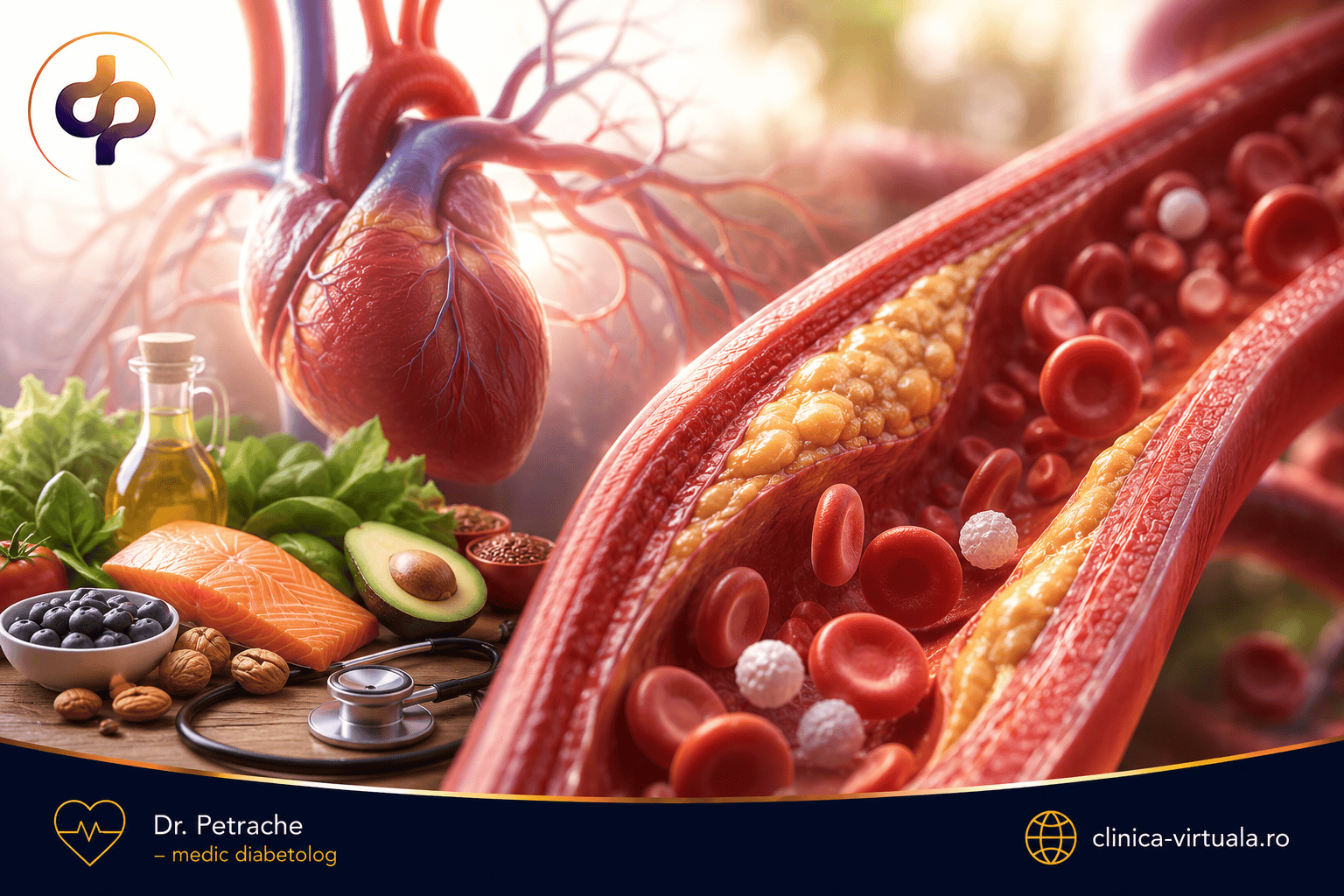

LDL Is Good… But Cardiovascular Risk May Remain? The Hidden Role of Inflammation
For years, cardiovascular prevention has focused on a few key indicators considered essential: LDL cholesterol, blood pressure, blood glucose levels, and smoking. These remain fundamental factors for maintaining healthy blood vessels and a healthy heart.
However, recent research suggests that the story does not end there.
There are patients whose cholesterol is well controlled, whose blood pressure is within target ranges, and whose diabetes is properly managed, yet they still experience heart attacks, strokes, or other cardiovascular complications.
Why does this happen?
One answer that is receiving increasing attention in medical research is chronic low-grade inflammation.
Tourist in Romania and in need of a prescription for your chronic treatment?
Contact Dr. Petrache’s Virtual Clinic for any medical issue you encounter while in Romania. Send an email to: clinica@diabet-si-nutritie.ro
Atherosclerosis Is Not Just a Cholesterol Disease
For a long time, atherosclerosis was viewed primarily as the accumulation of cholesterol within artery walls.
Today, we know the process is far more complex.
Cholesterol deposits trigger an ongoing inflammatory response. The immune system attempts to manage these deposits, but over time, inflammation can contribute to plaque instability and the development of cardiovascular events.
In other words, cholesterol and inflammation often work together.
Lowering cholesterol is extremely important, but it does not always completely eliminate the inflammatory process.
What Is hsCRP?
High-sensitivity C-reactive protein, commonly known as hsCRP, is one of the most widely used markers of systemic inflammation.
Unlike standard C-reactive protein, which is often used to detect infections or acute inflammatory conditions, hsCRP can identify much lower levels of inflammation.
In cardiology, this marker is used to assess residual cardiovascular risk.
Elevated levels may indicate an ongoing inflammatory process that continues to affect the blood vessels.
What Does an hsCRP Above 2 mg/L Mean?
Numerous studies have shown that an hsCRP level of at least 2 mg/L may identify individuals at increased cardiovascular risk.
This may be true even when LDL cholesterol is well controlled.
For this reason, many specialists believe hsCRP provides valuable information beyond the traditional lipid profile.
Two individuals may have identical LDL levels but very different cardiovascular risks if their levels of inflammation differ.
The POSEIDON Study and What It Reveals
Recent findings from the POSEIDON study have highlighted an important issue.
Researchers evaluated patients with atherosclerotic cardiovascular disease and chronic kidney disease, as well as individuals with cardiovascular disease but without kidney impairment.
The results showed that approximately half of the patients who had both cardiovascular disease and chronic kidney disease exhibited evidence of persistent cardiovascular inflammation, defined as an hsCRP level of at least 2 mg/L.
This occurred despite receiving standard cardiovascular therapies.
The message is important: controlling traditional risk factors may not always be enough.
Why Is Chronic Kidney Disease So Important?
The kidneys and cardiovascular system are closely connected.
Patients with chronic kidney disease frequently develop:
- Persistent inflammation
- Oxidative stress
- Endothelial dysfunction
- Accelerated vascular calcification
All of these mechanisms promote the progression of atherosclerosis.
For this reason, the combination of cardiovascular disease and chronic kidney disease is considered one of the highest-risk situations encountered in clinical practice.
Foreigner In Romania and in need of a prescription for your chronic treatment?
Contact Dr. Petrache’s Virtual Clinic for any medical issue you encounter while in Romania. Send an email to: clinica@diabet-si-nutritie.ro
Why Do Some People Still Have Heart Attacks?
This is one of the most important questions in modern cardiology.
A patient may have:
- Excellent LDL levels
- Well-controlled blood pressure
- Good glucose control
- Appropriate medical treatment
And yet still experience a cardiovascular event.
Residual inflammation is one possible explanation.
Today, a growing body of research is focused on finding ways to reduce this inflammatory risk.
Inflammation and Diabetes
For people living with diabetes, this topic is particularly relevant.
Diabetes is associated with a chronic inflammatory state that can affect blood vessels even when blood glucose levels appear reasonably well controlled.
This helps explain why two individuals with the same HbA1c may have very different cardiovascular outcomes.
In diabetes care, glucose control remains essential, but it is not the only goal.
Cardiovascular protection requires a much broader approach.
What Role Do Modern Medications Play?
In recent years, attention has shifted from simply lowering blood sugar to reducing overall cardiovascular risk.
Medications such as:
- Semaglutide
- Tirzepatide
- SGLT2 inhibitors
have demonstrated benefits that extend beyond glucose control and weight reduction.
Part of their positive impact may be related to reducing systemic inflammation.
This is one of the reasons these therapies have become so important in modern clinical guidelines.
Can Lifestyle Influence Inflammation?
Absolutely.
Inflammation is not influenced only by medications.
Many lifestyle factors contribute to chronic inflammation throughout the body.
Among the most important are:
- Smoking
- Excess body weight
- Physical inactivity
- Poor sleep
- Chronic stress
- Unbalanced nutrition
On the other hand, a Mediterranean-style diet, regular physical activity, and maintaining a healthy weight are associated with lower levels of inflammation.
Could hsCRP Become a Routine Marker?
It is possible.
Today, physicians commonly use LDL cholesterol, non-HDL cholesterol, and apolipoprotein B to evaluate cardiovascular risk.
As our understanding of inflammation continues to evolve, hsCRP may become an increasingly valuable tool for identifying patients who remain at risk despite standard treatment.
In the future, the question “What is the LDL level?” may routinely be followed by “What is the hsCRP level?”
Passing through Romania and need a prescription for your chronic treatment?
Contact Dr. Petrache’s Virtual Clinic for any medical issue you encounter while in Romania. Send an email to: clinica@diabet-si-nutritie.ro
Conclusion
For many years, atherosclerosis was viewed primarily as a cholesterol disease. Today, we understand that it is also a disease of inflammation.
Elevated cholesterol remains a major risk factor and should be treated appropriately. However, lowering LDL cholesterol does not always eliminate cardiovascular risk completely.
Recent evidence suggests that persistent inflammation may represent the missing piece of the puzzle for many patients.
The message is simple but extremely important: having a good LDL level is excellent news, but it does not always mean that cardiovascular risk has disappeared. In modern medicine, protecting the heart increasingly means looking beyond cholesterol and understanding the critical role that inflammation plays in long-term health.
Follow us on:
- FaceBook: Diabetes & Nutrition;
- YouTube: Diabetes Facts.