Expose Mushrooms to Sunlight Before Cooking Them

Expose Mushrooms to Sunlight Before Cooking Them
Mushrooms are among the very few plant-based foods capable of naturally producing vitamin D when exposed to ultraviolet light. For many people, it sounds almost unbelievable that a food can become “more nutritious” simply by sitting in the sun for a while, but in the case of mushrooms, this is real and scientifically documented.
In recent years, interest in vitamin D has increased enormously. More and more studies discuss its role in bone health, immune function, metabolism, muscle strength, and overall well-being. At the same time, vitamin D deficiency is extremely common, especially in regions with long winters, among people who spend most of their time indoors, or those who constantly use sun protection.
What many people do not know is that an incredibly simple trick can increase the vitamin D content of mushrooms right in your own kitchen: exposing them to sunlight before cooking.
Tourist in Romania and in need of a prescription for your chronic treatment?
Contact Dr. Petrache’s Virtual Clinic for any medical issue you encounter while in Romania. Send an email to: clinica@diabet-si-nutritie.ro
How Mushrooms Produce Vitamin D
Mushrooms contain a substance called ergosterol. When exposed to ultraviolet radiation, this compound transforms into vitamin D2.
The process is surprisingly similar to what happens in human skin. We also produce vitamin D when UV rays interact with certain molecules in our skin. This makes mushrooms quite unique in the plant world.
In nature, mushrooms often grow in shaded environments, so they do not always naturally contain high amounts of vitamin D. However, when exposed to sunlight or UV lamps, their vitamin D levels can increase dramatically.
Some studies have shown that UV exposure can raise vitamin D content dozens of times higher than the original levels.
What Type of Vitamin D Do Mushrooms Produce?
Mushrooms mainly produce vitamin D2, also known as ergocalciferol.
Most people are more familiar with vitamin D3, the form produced by human skin and commonly found in fatty fish, eggs, and many supplements.
There is ongoing debate regarding the effectiveness of D2 versus D3. In general:
- both forms can increase vitamin D levels in the blood;
- vitamin D3 may remain active longer in the body;
- vitamin D2 is still considered a valuable source, especially for vegetarians and vegans.
So while mushrooms are not equivalent to a powerful vitamin D3 supplement, they can still make a meaningful contribution to dietary intake.
How to Properly Expose Mushrooms to Sunlight
The process is surprisingly simple.
Ideally:
- use raw mushrooms;
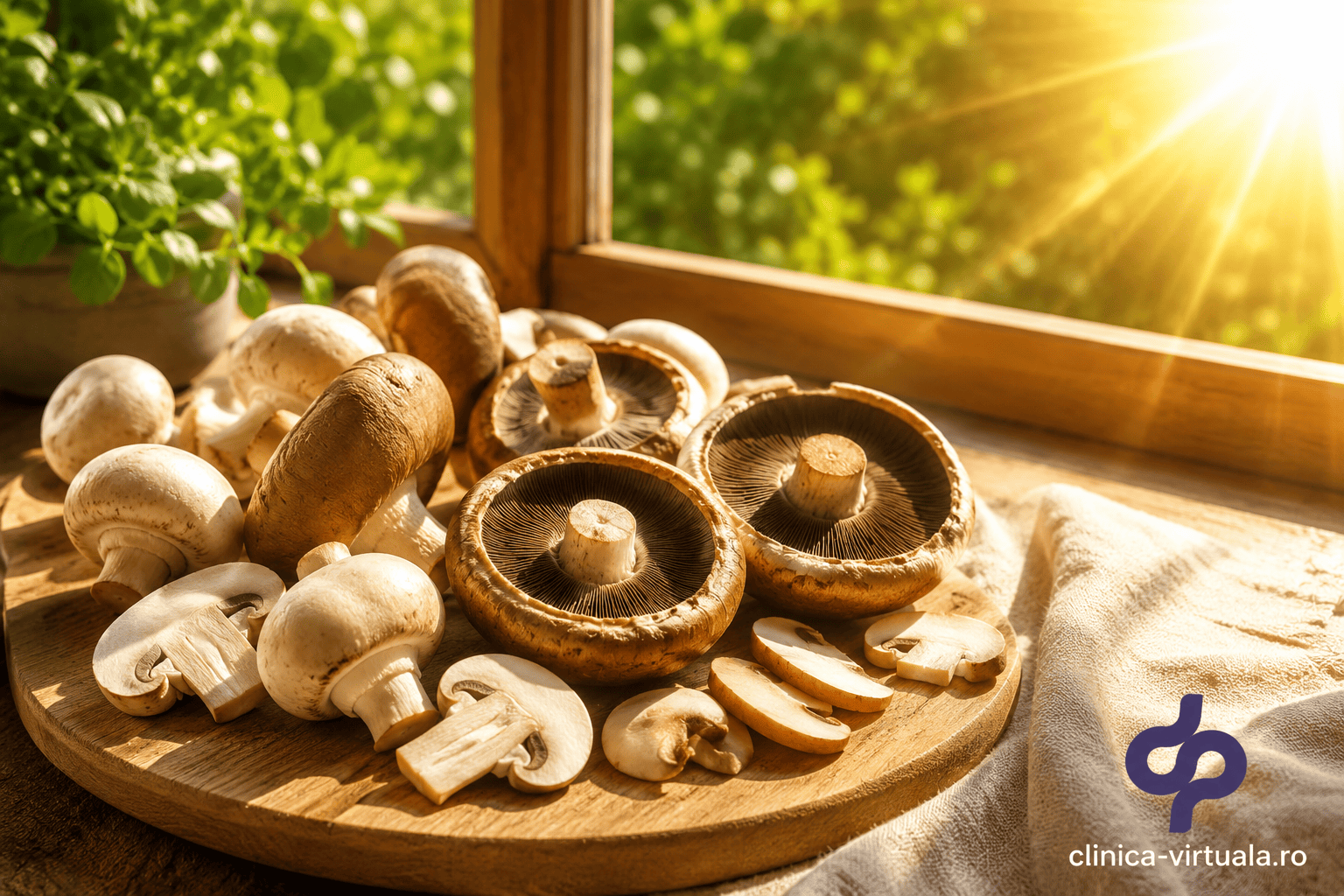
- slice them or place them gill-side up;
- expose them directly to sunlight;
- leave them in the sun for approximately 15–60 minutes.
The exact time depends on:
- sunlight intensity;
- season;
- mushroom thickness;
- exposed surface area.
In general, midday sunlight works better than weak morning or evening light.
Sliced mushrooms usually produce more vitamin D because more surface area is exposed.
Which Mushrooms Work Best?
Several mushroom varieties respond very well to UV exposure:
- button mushrooms;
- shiitake;
- maitake;
- oyster mushrooms;
- portobello mushrooms.
Shiitake and maitake are often praised for both their rich nutritional profile and their strong ability to produce vitamin D after UV exposure.
However, even ordinary supermarket button mushrooms can become a much more interesting source of vitamin D when exposed to sunlight before cooking.
Does Cooking Destroy Vitamin D?
Some vitamin D may be lost during cooking, but not all of it.
Studies show that a significant amount remains after:
- sautéing;
- baking;
- boiling;
- oven cooking.
This means mushrooms do not need to be eaten raw in order to benefit from the effect.
However, excessive burning or prolonged exposure to extremely high temperatures should be avoided.
Foreigner In Romania and in need of a prescription for your chronic treatment?
Contact Dr. Petrache’s Virtual Clinic for any medical issue you encounter while in Romania. Send an email to: clinica@diabet-si-nutritie.ro
Can Mushrooms Become an Important Source of Vitamin D?
That depends on several factors:
- exposure time;
- mushroom type;
- UV intensity;
- amount consumed.
In some cases, vitamin D levels can become surprisingly high. Certain commercially UV-treated mushrooms may provide a substantial portion of the daily recommended intake in a single serving.
At home, however, it is difficult to estimate the exact amount produced.
For this reason, exposing mushrooms to sunlight should be viewed as:
- an interesting way to naturally enrich food;
- a potentially useful nutritional strategy;
- not necessarily a replacement for treating severe vitamin D deficiency.
Why Is Vitamin D So Important?
Vitamin D plays a major role in:
- calcium absorption;
- bone health;
- muscle function;
- immune support;
- metabolism.
Severe deficiency may contribute to:
- osteopenia;
- osteoporosis;
- muscle weakness;
- increased fall risk;
- bone pain;
- fatigue.
In recent years, researchers have also studied potential links between vitamin D and:
- diabetes;
- obesity;
- autoimmune diseases;
- infections;
- cardiovascular health.
Still, it is important to avoid exaggerated claims. Vitamin D is not a universal miracle, and supplementation should ideally be guided by medical evaluation and blood tests.
Mushrooms and Modern Nutrition
Interest in mushrooms has grown enormously because they offer:
- very few calories;
- fiber;
- satisfying texture;
- umami flavor;
- minerals;
- antioxidants.
The fact that they can also produce vitamin D makes them even more nutritionally fascinating.
At a time when many foods are heavily ultra-processed, the idea that a simple ingredient can become more nutritious simply through natural sunlight exposure feels almost poetic.
Are There Any Limitations?
Yes.
Sun exposure does not transform mushrooms into medicine. It cannot independently correct severe vitamin D deficiency and should not replace medical recommendations when significant deficiency exists.
Additionally:
- vitamin D production varies considerably;
- some store-bought mushrooms may already be UV-treated;
- long storage times may reduce vitamin D levels;
- not everyone absorbs vitamin D equally well.
People with:
- malabsorption syndromes;
- digestive diseases;
- severe obesity;
- liver disease;
- kidney disease;
may require medical assessment and specific supplementation.
Passing through Romania and need a prescription for your chronic treatment?
Contact Dr. Petrache’s Virtual Clinic for any medical issue you encounter while in Romania. Send an email to: clinica@diabet-si-nutritie.ro
A Small but Fascinating Trick
Exposing mushrooms to sunlight before cooking is one of those fascinating examples where biology and nutrition meet in an unexpected way.
It requires no special equipment.
It costs nothing.
It does not involve complicated supplements.
Simply:
- slice the mushrooms,
- leave them in the sunlight for a while,
- then cook them.
Sometimes the most interesting nutritional tricks are also the simplest.
Follow us on:
- FaceBook: Diabetes & Nutrition;
- YouTube: Diabetes Facts.