New! Sensor for Glucose and Ketones
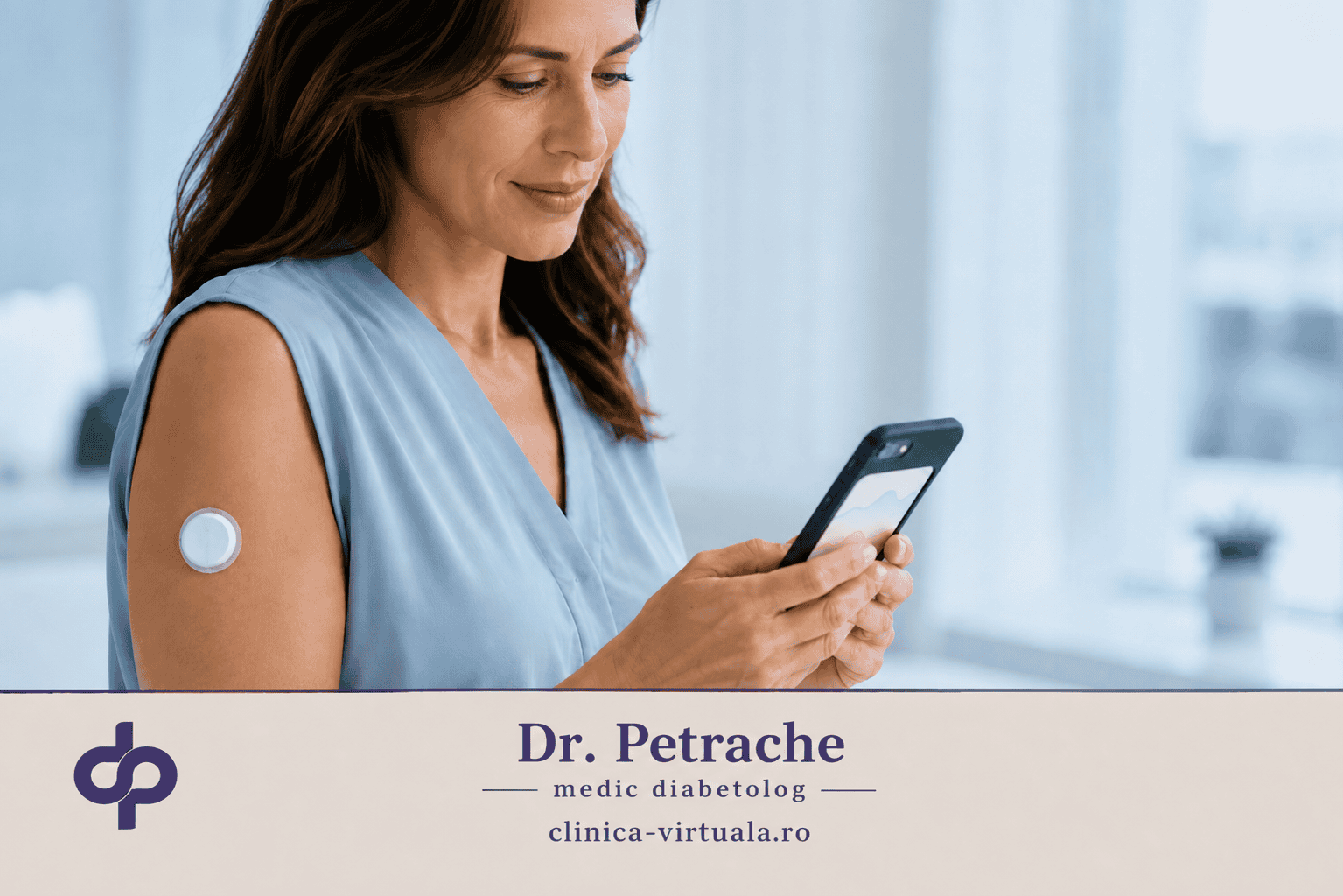

Abbott Libre Duo 10 Day: The New Sensor That Continuously Monitors Glucose and Ketones
Abbott has announced that Libre Duo 10 Day, a new system that continuously monitors both glucose and ketones using a single sensor, has received CE marking.
The manufacturer describes it as the first dual sensor of its kind. Readings are taken from the interstitial fluid and automatically transmitted to an app installed on a compatible smartphone.
Libre Duo 10 Day could represent an important advancement for people with diabetes who are at risk of diabetic ketoacidosis. However, the sensor is not currently available for purchase in Romania, and Abbott has not announced a date for its launch on the Romanian market.
Tourist in Romania and in need of a prescription for your chronic treatment?
Contact Dr. Petrache’s Virtual Clinic for any medical issue you encounter while in Romania. Send an email to: clinica@diabet-si-nutritie.ro
What is Abbott Libre Duo 10 Day?
Libre Duo 10 Day is a wearable device that simultaneously monitors:
- glucose levels in the interstitial fluid;
- ketone levels in the interstitial fluid.
The sensor can be worn for up to 10 days and is intended for people with diabetes aged 2 years and older.
Readings are updated every minute and automatically transmitted to a compatible app. Users can see their current glucose and ketone levels, as well as the direction in which they are changing.
The system is designed to issue alerts when ketone levels rise and reach a level requiring attention.
How is Libre Duo different from a standard glucose sensor?
Currently available continuous glucose monitoring systems measure glucose but do not monitor ketones. They display glucose levels and trends and may issue alerts for hypoglycaemia or hyperglycaemia.
Libre Duo 10 Day adds continuous ketone monitoring to the same device.
This difference is important because glucose and ketone levels do not always change in parallel. Ketones can sometimes rise before glucose reaches very high levels or even while glucose appears to remain within an acceptable range.
Until now, a person who needed to check their ketones had to perform a separate blood or urine test. These methods provide only a single reading corresponding to the moment when the test was carried out.
Continuous monitoring can show whether ketone levels are stable, falling or rising.
Tourist in Romania and in need of a prescription for your chronic treatment?
Contact Dr. Petrache’s Virtual Clinic for any medical issue you encounter while in Romania. Send an email to: clinica@diabet-si-nutritie.ro
Why is ketone monitoring important?
Ketones are produced when the body uses fat as a source of energy. Their presence does not automatically mean that a person has diabetic ketoacidosis.
Ketones can also appear during fasting, when following a very low-carbohydrate diet or after prolonged physical activity.
However, in a person with diabetes and insufficient insulin, ketones can accumulate rapidly. This can make the blood acidic and lead to diabetic ketoacidosis, a serious complication requiring emergency medical treatment.
Diabetic ketoacidosis occurs most frequently in people with type 1 diabetes, but it can also develop in people with type 2 diabetes.
Situations that may increase the risk include:
- missing insulin doses;
- taking an insufficient amount of insulin;
- interrupted insulin delivery due to an insulin pump problem;
- infections and acute illnesses;
- vomiting and dehydration;
- surgery;
- reduced food intake combined with insufficient insulin;
- certain situations associated with SGLT2 inhibitor treatment.
Diabetic ketoacidosis can develop within just a few hours. Continuous access to ketone readings could help users recognise a dangerous trend sooner.
Ketones can rise without very high glucose levels
One of the most important advantages of simultaneous monitoring is the possibility of detecting rising ketone levels when glucose does not appear to be alarmingly high.
In euglycaemic diabetic ketoacidosis, glucose may be normal or only moderately elevated while ketones accumulate and acidosis continues to worsen.
This situation is particularly associated with SGLT2 inhibitors, although it may also occur in other circumstances.
A standard continuous glucose monitor cannot directly identify this risk because it only measures glucose. Libre Duo 10 Day could provide the missing information by showing that ketone levels are rising.
The sensor cannot diagnose diabetic ketoacidosis on its own, but it may alert the user that they need to follow their ketone management plan or seek medical assistance.
Foreigner In Romania and in need of a prescription for your chronic treatment?
Contact Dr. Petrache’s Virtual Clinic for any medical issue you encounter while in Romania. Send an email to: clinica@diabet-si-nutritie.ro
Who could benefit from Libre Duo 10 Day?
The sensor could be particularly useful for:
- people with type 1 diabetes;
- children and adolescents with diabetes;
- people treated with insulin;
- insulin pump users;
- people who have previously experienced diabetic ketoacidosis;
- people with type 2 diabetes who are at risk of ketosis;
- certain patients treated with SGLT2 inhibitors;
- people who may find it difficult to recognise the symptoms of diabetic ketoacidosis.
Ketone monitoring may be particularly useful during an acute illness, when insulin requirements may change and the risk of diabetic ketoacidosis may increase.
However, the practical usefulness of the device will depend on the individual medical indication and the existence of a clear action plan for rising ketone levels.
How will the data be monitored?
Libre Duo 10 Day will be integrated into the Libre digital ecosystem. Users will be able to see both glucose and ketone readings in the app.
The information will also be shareable with caregivers and healthcare professionals through Abbott’s digital platforms.
The company is working on integrating the sensor with automated insulin delivery systems. Compatibility with a particular insulin pump, app or smartphone model will nevertheless need to be checked for each country and device.
CE marking does not automatically guarantee compatibility with every insulin pump marketed in Europe.
What does the sensor not replace?
Libre Duo 10 Day may provide an additional level of safety, but it does not replace:
- correct insulin administration;
- sick-day rules;
- an individual action plan for elevated ketones;
- adequate hydration;
- verification using the method recommended by a doctor when the sensor reading does not match the person’s symptoms;
- urgent medical assessment when symptoms suggesting diabetic ketoacidosis occur.
Like glucose sensors, Libre Duo measures values in the interstitial fluid rather than directly in the blood. When levels change rapidly, there may be differences between the sensor reading and the result obtained from a blood test.
Ketone readings must be interpreted together with glucose levels, symptoms and the overall clinical context.
Warning signs of diabetic ketoacidosis may include:
- nausea or vomiting;
- abdominal pain;
- intense thirst;
- frequent urination;
- dehydration;
- rapid or deep breathing;
- fruity-smelling breath;
- extreme tiredness;
- drowsiness;
- confusion;
- a significant deterioration in general health.
Diabetic ketoacidosis is a medical emergency. If these symptoms occur, seeking medical assistance must not be delayed while waiting for another sensor reading or alert.
Is Libre Duo 10 Day available in Europe?
Libre Duo 10 Day has received CE marking, meaning that it meets the applicable European requirements for medical devices.
However, CE marking does not mean that the product can be purchased immediately in every European country.
Abbott has announced that it intends to begin launching the Libre Duo systems in selected European countries during 2026. The company has not specified all the countries included in the initial rollout and has not yet published a complete launch timetable.
Libre Duo 10 Day is not currently commercially available in Romania.
Which sensors are available in Romania?
Abbott FreeStyle Libre sensors are not currently officially available on the Romanian market, and Libre Duo 10 Day cannot be purchased in Romania.
People who wish to use a continuous monitoring system can find sensors currently available in Romania at PrimeMedical.ro.
The available range includes:
- continuous glucose monitoring sensors;
- continuous ketone monitoring sensors;
- blood glucose meters and diabetes monitoring accessories.
Products and stock availability may change over time.
A separate ketone sensor is not equivalent to Libre Duo 10 Day. In this situation, the user needs two different devices: one to monitor glucose and another to monitor ketones.
The choice of sensor should take into account the medical indication, accuracy, wear duration, alerts, smartphone compatibility, data-sharing options and cost.
Passing through Romania and need a prescription for your chronic treatment?
Contact Dr. Petrache’s Virtual Clinic for any medical issue you encounter while in Romania. Send an email to: clinica@diabet-si-nutritie.ro
Conclusion
Abbott Libre Duo 10 Day represents an important advancement in diabetes monitoring. The ability to continuously track glucose and ketones using the same device could help people recognise situations associated with a risk of diabetic ketoacidosis sooner.
The technology could be particularly valuable for people with type 1 diabetes, insulin users and patients whose ketone levels may rise without obvious hyperglycaemia.
Libre Duo 10 Day does not eliminate the risk of diabetic ketoacidosis and does not replace insulin, diabetes education or emergency medical assessment. Its main advantage is the continuous monitoring of a parameter that previously had to be checked separately and only at specific times.
Although the sensor has received CE marking, it is not yet available in Romania, and no date has been announced for its launch on the Romanian market. Until then, people interested in continuous monitoring can use the sensors currently available in Romania, depending on their doctor’s recommendation and their individual needs.
Sources
- Abbott – CE marking for Libre Duo technology
- The Lancet Diabetes & Endocrinology – international recommendations on continuous ketone monitoring
- NHS – diabetic ketoacidosis
- Prime Medical – sensors available in Romania
The information provided in this article is for educational purposes only and does not replace medical consultation, diagnosis or individual treatment recommendations.
Follow us on:
- FaceBook: Diabetes & Nutrition;
- YouTube: Diabetes Facts.