Egg Yolk Color – What Does It Actually Tell Us?
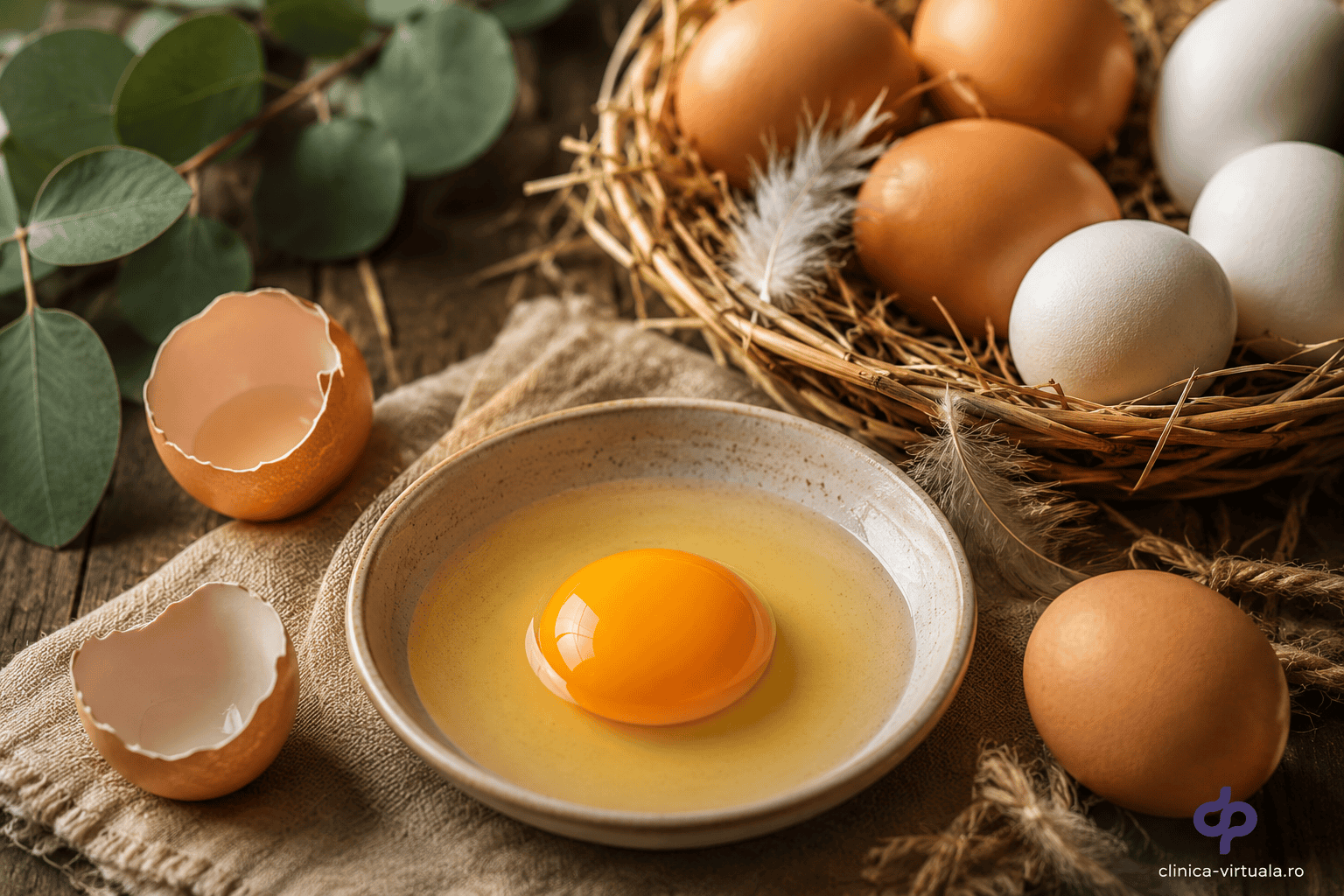
Few things spark as many kitchen debates as the color of an egg yolk. Many people are convinced that a deep orange yolk automatically means the egg is “healthier,” “more natural,” or simply “better.” On the other hand, a pale yellow yolk is often viewed with suspicion and considered inferior.
The reality, however, is more complex. The color of the yolk can reveal certain things about the hen’s diet and the pigments present in its feed, but it is not always a perfect indicator of nutritional quality.
Moreover, the food industry understands very well how strongly color influences consumer perception. That is why intensely colored yolks are not always exactly what they seem.

Tourist in Romania and in need of a prescription for your chronic treatment?
Contact Dr. Petrache’s Virtual Clinic for any medical issue you encounter while in Romania. Send an email to: clinica@diabet-si-nutritie.ro
Why Does the Yolk Have Color?
The color of the yolk is mainly influenced by pigments called carotenoids. These are natural compounds found in:
- corn;
- alfalfa;
- grass;
- flowers;
- peppers;
- certain algae;
- various plants.
When hens consume feed rich in carotenoids, these pigments are deposited into the yolk.
This is why free-range hens that eat:
- grass;
- insects;
- a varied plant-based diet;
can sometimes produce eggs with darker, more intensely colored yolks.
In contrast, a diet based mainly on grains lower in pigments may lead to paler yolks.
A Dark Orange Yolk Does NOT Automatically Mean “Organic”
This is one of the most common misconceptions.
Many people assume:
deep orange yolk = organic egg or happy hen.
Sometimes that may be true. But in other cases, the color is intentionally influenced through specially designed feed.
The poultry industry often supplements feed with natural or synthetic pigments to obtain the yolk color consumers prefer.
Because yes, most consumers tend to prefer more intensely colored yolks.
As a result, even industrially raised hens can produce very orange yolks if they are given specially formulated feed.
Preferences Differ Greatly Between Countries
The perception of the “ideal yolk” is surprisingly cultural.
In some countries:
- a deep orange yolk is associated with naturalness and superior quality.
In others:
- consumers prefer a softer yellow color.
The food industry frequently adjusts hen feed based on local consumer preferences.
Does the Color Matter for Health?
Within certain limits, a more intensely colored yolk may suggest higher amounts of carotenoids such as:
- lutein;
- zeaxanthin.
These compounds are interesting because they act as antioxidants and are associated particularly with eye health.
However, the differences are not always dramatic, and we cannot judge an egg’s quality based only on color.
A paler yolk:
- does not automatically mean the egg is “bad”;
- does not mean the hen was unhealthy;
- and does not necessarily indicate poor nutritional value.
Likewise, an intensely colored yolk:
- does not guarantee the egg is organic;
- does not guarantee ideal farming conditions;
- and does not automatically mean superior quality.
The Hen’s Diet Greatly Influences the Egg
Although color does not tell the whole story, the hen’s diet truly does affect the composition of the egg.
For example, hens fed differently may produce eggs with:
- different fatty acid profiles;
- varying omega-3 content;
- different levels of fat-soluble vitamins;
- varying concentrations of carotenoids.
Some farms even deliberately modify feed to create:
- omega-3 enriched eggs;
- vitamin-enriched eggs;
- eggs with darker yolks.
Foreigner In Romania and in need of a prescription for your chronic treatment?
Contact Dr. Petrache’s Virtual Clinic for any medical issue you encounter while in Romania. Send an email to: clinica@diabet-si-nutritie.ro
Very Dark Yolks Can Also Occur Naturally
Sometimes people are surprised or even concerned when they see yolks that are almost orange-red.
This can happen naturally if hens consume:
- large amounts of carotenoid-rich plants;
- peppers;
- deeply pigmented corn;
- certain flowers or algae.
In some traditional rural settings, free-roaming hens with diverse diets may naturally produce very intensely colored yolks without any artificial supplementation.
Yolk Texture Matters Too
Not only color influences how people perceive egg quality.
Many people also notice:
- consistency;
- firmness;
- how the yolk behaves during cooking.
A firmer, denser yolk is often associated with freshness.
Very fresh eggs tend to:
- hold their shape better;
- have a more rounded yolk;
- and have a thicker egg white.
As the egg ages:
- the egg white becomes more watery;
- the structure changes;
- the yolk may become more fragile.
Are There Differences Between Store-Bought and Farm Eggs?
Sometimes yes, but not always in the idealized way often presented online.
Eggs from small household farms may have:
- more varied feed;
- outdoor access;
- different flavor profiles;
- darker yolks.
However, “farm eggs” are not automatically perfect.
Quality depends on:
- the hen’s diet;
- hygiene;
- freshness;
- storage conditions;
- the bird’s health.
In some cases, commercially produced eggs from well-controlled farms may actually meet stricter microbiological safety standards than informal sources.
Yolk Color and Cholesterol
Another common misconception is that darker yolks contain “more cholesterol.”
In reality, yolk color and cholesterol are not directly linked in a simple way.
The cholesterol content of eggs depends on other biological factors, not just pigmentation.
In addition, modern discussions about cholesterol and eggs are far more nuanced than in the past. For most healthy individuals, moderate egg consumption can absolutely be part of a balanced diet.
Cooking Method Matters Too
Sometimes the difference between a healthy egg meal and a less healthy one comes more from preparation than from yolk color.
Eggs eaten:
- with plenty of vegetables;
- as part of a balanced meal;
- using gentle cooking methods,
can play a very beneficial role in nutrition.
In contrast, meals that are:
- highly processed;
- excessively fried;
- constantly associated with fast food,
completely change the nutritional context.
Eggs and Balanced Nutrition
Eggs are an excellent source of:
- protein;
- choline;
- vitamin B12;
- selenium;
- lutein;
- satisfying fats.
For many people, they can be a highly practical and nutritious food.
Still, as with almost everything in nutrition, the overall dietary pattern matters far more than obsessing over a single detail such as yolk color.
Passing through Romania and need a prescription for your chronic treatment?
Contact Dr. Petrache’s Virtual Clinic for any medical issue you encounter while in Romania. Send an email to: clinica@diabet-si-nutritie.ro
Conclusion
Egg yolk color can provide certain clues about the hen’s diet and the pigments present in its feed, but it is not a perfect detector of quality.
An intensely colored yolk may result from:
- a naturally varied diet;
- or from controlled feed supplementation.
A paler yolk does not automatically mean poor quality.
In reality, when evaluating eggs, much more important factors include:
- freshness;
- food safety;
- farming conditions;
- the hen’s overall nutrition;
- and the broader context of human nutrition.
Very often, healthy eating is less about extremes and more about balance, variety, and sustainable long-term choices.
Follow us on:
- FaceBook: Diabetes & Nutrition;
- YouTube: Diabetes Facts.