Did you bleed after your Mounjaro injection? The simple explanation

What’s actually happening
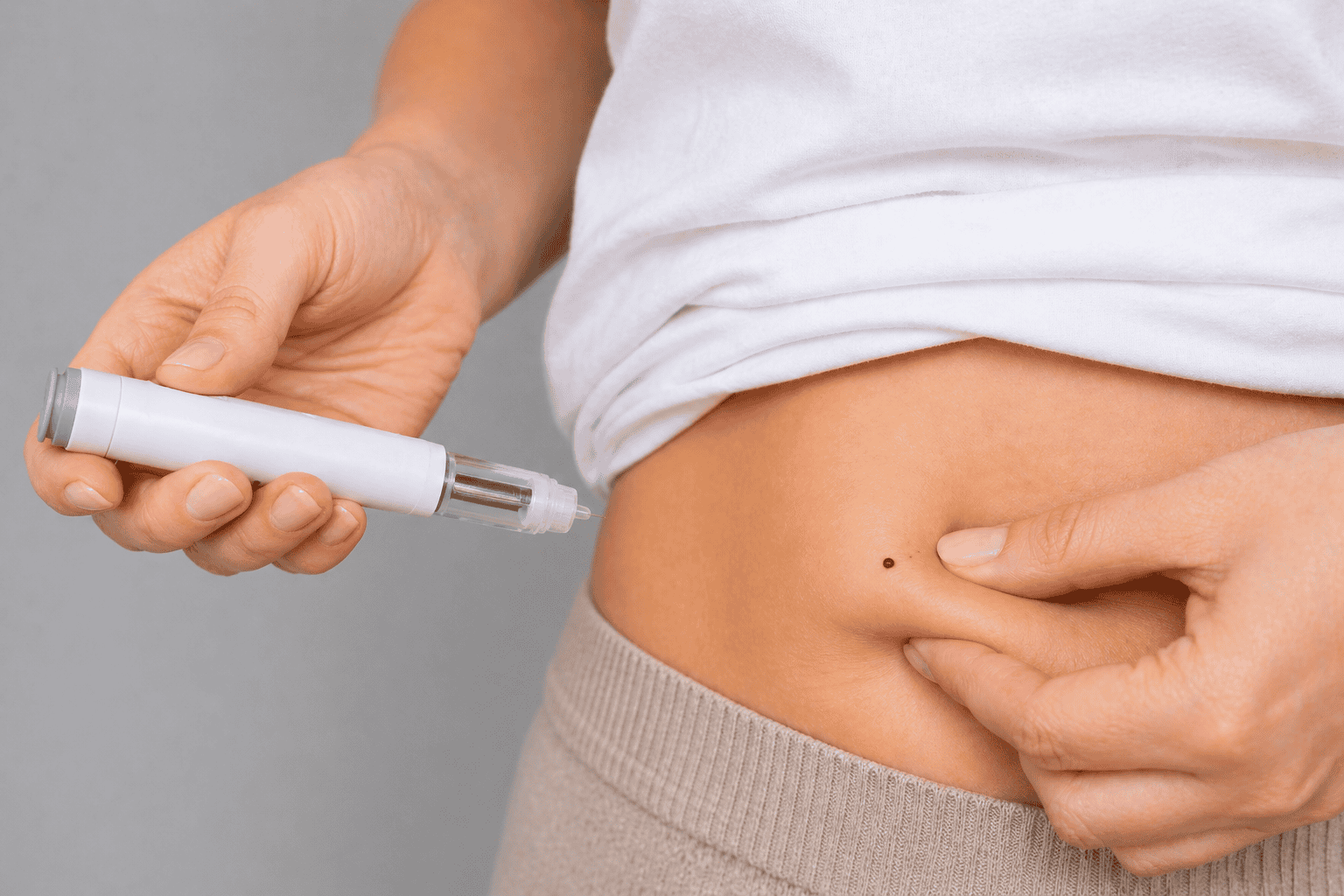
If you noticed a small drop of blood after an injection with Mounjaro, your first reaction might be concern. In reality, the explanation is simple and reassuring.
The skin is richly supplied with tiny blood vessels. Even in the subcutaneous layer—where these injections are given—there is a fine network of capillaries that cannot be seen with the naked eye. When the needle passes through the skin, it may occasionally nick one of these small vessels. That’s what causes the small drop of blood you see.
This has nothing to do with the medication itself and does not mean the injection was done incorrectly. It is simply a minor mechanical event.
Tourist in Romania and in need of a prescription for your chronic treatment?
Contact Dr. Petrache’s Virtual Clinic for any medical issue you encounter while in Romania. Send an email to: clinica@diabet-si-nutritie.ro
Is it normal or should you worry?
In most cases, it is completely normal. In fact, if you inject regularly, it is almost inevitable that it will happen from time to time. Even experienced patients with excellent technique encounter this occasionally.
Usually, the bleeding is minimal, stops quickly, and leaves no trace or, at most, a small mark. Sometimes a minor bruise may appear, especially if the capillary was slightly larger, but it resolves on its own within a few days.
Importantly, this does not affect how well the treatment works. The medication has already been delivered into the subcutaneous tissue and is not “lost” with that drop of blood.
Why it happens sometimes and not others
Many patients notice that some injections are completely clean, while others lead to slight bleeding. This variability is related to local anatomy, not your technique.
Certain areas have a denser or more superficial capillary network. Even within the same region, the distribution of these tiny vessels is uneven. Each injection carries a small element of chance.
Other subtle factors also play a role, such as how tense the skin is at the moment of injection, the angle of the needle, or whether the area has been recently irritated or traumatized. All of these can influence the likelihood of hitting a capillary.
What should you do when it happens?
If you see a drop of blood, the best approach is to stay calm and keep things simple. Applying gentle pressure with a clean swab for a few seconds is enough to stop the bleeding. There is no need to rub or massage the area, as this may increase the chance of bruising.
Once the bleeding has stopped, you can carry on as usual. There is no need to repeat the injection or adjust the dose. The medication has already been properly administered.
What does a bruise mean?
A bruise is simply a small amount of blood trapped under the skin. It is not dangerous and does not indicate a serious issue. Some patients experience it rarely, while others may see it more often, especially if their skin is more sensitive or their blood vessels are more fragile.
Over a few days, the color changes and fades, just like any minor bruise. No treatment is required, although applying a cold compress immediately after injection may reduce its size if it bothers you.
Does the injection site matter?
The area you choose for injection can influence your experience. The abdomen is most commonly used because it is accessible and generally well tolerated. The thigh and upper arm are alternatives, but each area has its own characteristics.
Rotating injection sites is important not only to prevent irritation or small lumps under the skin, but also to avoid repeatedly traumatizing the same spot. Injecting in the exact same place increases the likelihood of local reactions, including minor bleeding or bruising.
Foreigner In Romania and in need of a prescription for your chronic treatment?
Contact Dr. Petrache’s Virtual Clinic for any medical issue you encounter while in Romania. Send an email to: clinica@diabet-si-nutritie.ro
Is it a mistake or just chance?
It is very easy to interpret bleeding as a personal mistake. In reality, in most cases, it has nothing to do with how well you performed the injection.
Even with perfect technique, you cannot see or avoid every tiny capillary. That is why healthcare professionals consider these small bleeding events to be normal and clinically insignificant.
Of course, proper technique helps—using the right angle, maintaining a steady motion, and choosing a suitable site—but it cannot eliminate the possibility entirely.
When should it raise concern?
Although rare, there are situations where you should pay closer attention. If the bleeding is more than minimal, does not stop quickly, or if you notice large bruises, increasing pain, redness, or warmth in the area, it is worth seeking medical advice.
Similarly, if you experience bleeding after nearly every injection, it may be helpful to review your technique or discuss possible contributing factors, such as medications that affect blood clotting.
These situations are the exception, not the rule.
Does it affect the treatment?
One of the most common concerns is that bleeding means the medication was “lost.” In reality, the amount of blood is negligible and does not affect treatment effectiveness.
The medication is already deposited in the subcutaneous tissue, where it is gradually absorbed. The blood you see comes from a superficial capillary, not from the injection site itself.
There is no need to repeat the injection or worry about reduced effectiveness.
Passing through Romania and need a prescription for your chronic treatment?
Contact Dr. Petrache’s Virtual Clinic for any medical issue you encounter while in Romania. Send an email to: clinica@diabet-si-nutritie.ro
Conclusion
A small drop of blood after a Mounjaro injection is, in most cases, completely normal. It simply means a tiny capillary was touched—nothing more.
It is not a sign of error, not a side effect of the medication, and it does not affect how the treatment works. It can happen occasionally, even with perfect technique, and requires only a calm, simple response.
Once you understand this, the anxiety around injections fades. And that, in practice, makes it much easier to stay consistent with your treatment over time.
Follow us on:
- FaceBook: Diabetes & Nutrition;
- YouTube: Diabetes Facts.