If Raw Salmon Has White Lines, Then…
Most people assume that buying salmon automatically means making a healthy choice. In reality, there can be important quality differences between two salmon fillets sitting side by side in the same store.
One of the easiest details to observe is the appearance of the white lines running through the flesh.
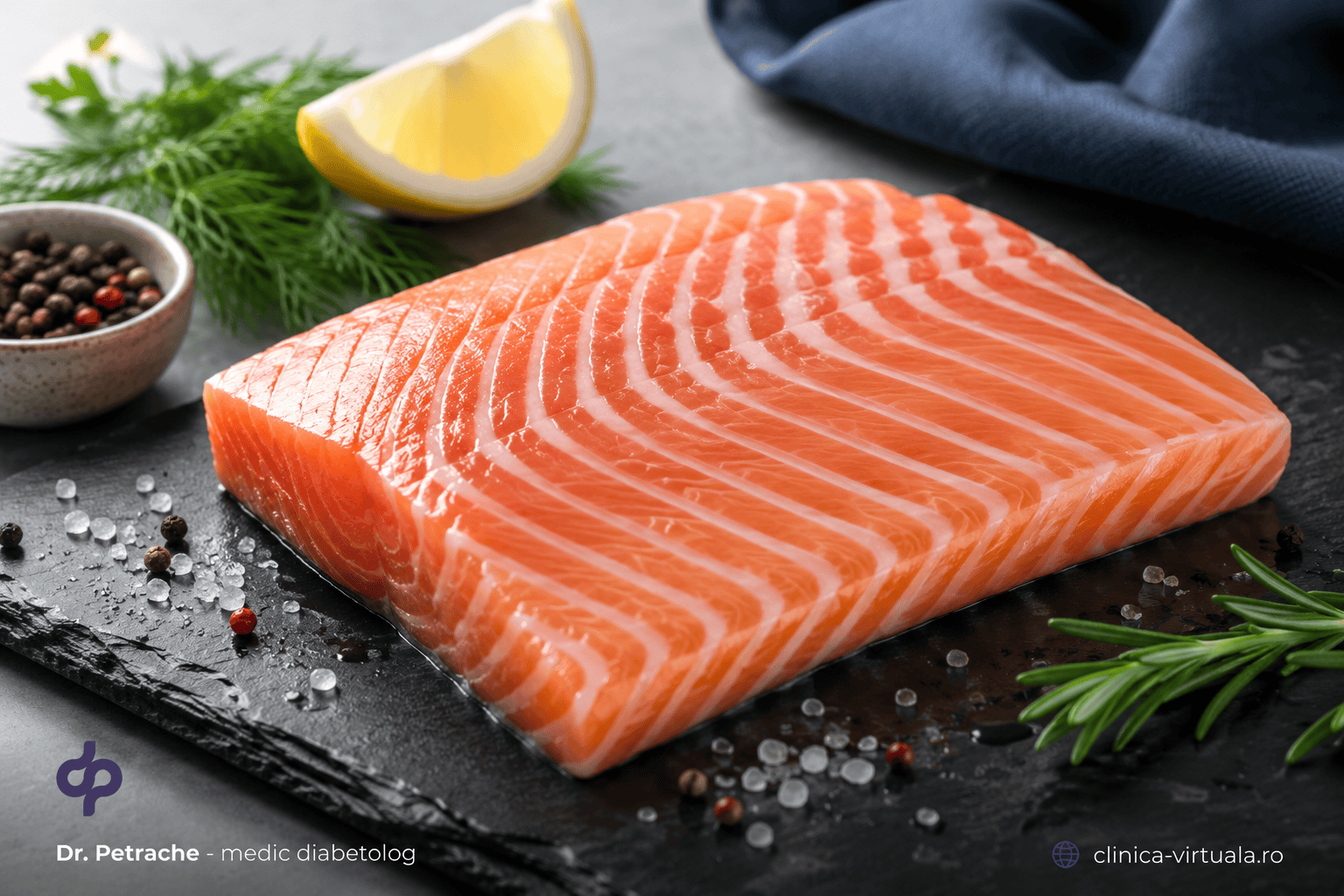
If raw salmon has very thick and numerous white lines, it may not be the best option available.

Tourist in Romania and in need of a prescription for your chronic treatment?
Contact Dr. Petrache’s Virtual Clinic for any medical issue you encounter while in Romania. Send an email to: clinica@diabet-si-nutritie.ro
What Are the White Lines in Raw Salmon?
The white lines visible before cooking are layers of fat located between the muscle fibers.
All salmon contain some fat.
The difference is that not all salmon contain the same amount.
The appearance of these lines can provide clues about how the fish was raised and its overall composition.
The Thicker the White Lines, the Fattier the Fish Usually Is
In general, very thick white lines indicate a higher amount of fat.
This is commonly seen in salmon raised in intensive aquaculture systems.
These fish are fed regularly, exercise less, and accumulate more fat between their muscle fibers.
The result is a more pronounced marbled appearance.
What Does Wild Salmon Usually Look Like?
Wild salmon must swim hundreds or even thousands of kilometers throughout its life.
As a result, it develops stronger muscles and stores less fat.
This is why the white lines are typically:
- Thinner
- Less numerous
- More subtle
The flesh is often firmer and more compact.
Does That Mean Any Salmon with White Lines Is Bad?
No.
This is one of the most common misconceptions.
White lines are not an absolute quality test.
There are excellent farmed salmon and there are wild salmon that do not look perfect.
However, when comparing two similar fillets, the one with very thick white lines is often fattier and more likely to come from an intensive farming system.
What Does This Have to Do with Contaminants?
This is where things become interesting.
Many environmental contaminants are fat-soluble, meaning they tend to accumulate in fatty tissues.
The more fat a fish contains, the greater its potential to accumulate certain substances present in the environment or feed.
This does not mean that every fatty salmon is contaminated.
It simply means that fat is one of the compartments where some undesirable substances may accumulate.
What About Lead?
Lead cannot be identified with the naked eye.
No one can look at a salmon fillet and determine whether it contains lead.
The only reliable method is laboratory testing.
However, choosing products from reputable suppliers with strong quality controls can help reduce risk.
Foreigner In Romania and in need of a prescription for your chronic treatment?
Contact Dr. Petrache’s Virtual Clinic for any medical issue you encounter while in Romania. Send an email to: clinica@diabet-si-nutritie.ro
What Else Should You Look At?
Color
Many consumers automatically choose the brightest orange fillet.
This is not always the best approach.
In fish farms, color can be influenced by pigments added to feed.
An extremely intense color does not automatically mean superior quality.
Texture
High-quality salmon should have:
- Well-defined muscle fibers
- A firm appearance
- A smooth surface
- Compact flesh
Moisture
If you notice excessive liquid in the package, the product may not be in optimal condition.
Smell
Fresh salmon should have a mild odor.
A strong fishy smell is a warning sign.
What Do I Look For When Buying Salmon?
If the goal is to choose a high-quality salmon fillet, I usually pay attention to:
- Clear origin information
- Good traceability
- Firm flesh
- Finer white lines
- A natural appearance
- Minimal excess liquid in the packaging
No single criterion guarantees quality, but together they provide useful clues.
Is Farmed Salmon Dangerous?
No.
Most salmon sold in Europe comes from fish farms and undergoes food safety inspections.
The issue is not that farmed salmon is toxic.
The issue is that there can be major differences between producers, farming practices, and feed quality.
Passing through Romania and need a prescription for your chronic treatment?
Contact Dr. Petrache’s Virtual Clinic for any medical issue you encounter while in Romania. Send an email to: clinica@diabet-si-nutritie.ro
Conclusion
If raw salmon has very thick white lines, it most likely contains more fat and comes from an intensive farming operation.
If the white lines are thin and subtle, there is a greater chance that you are looking at a leaner fish that more closely resembles the appearance of wild salmon.
The white lines do not tell you whether the fish contains lead, nor are they a perfect quality test.
However, when comparing multiple fillets, they can provide a simple and useful clue about how the fish was raised.
The next time you stand in front of the salmon counter, do not focus only on the color. Take a closer look at the white lines as well.
Sometimes, they reveal more than the label.
Follow us on:
- FaceBook: Diabetes & Nutrition;
- YouTube: Diabetes Facts.