JNK3 and Beta Pancreatic Cells

A New Pathway Through Which GLP-1 Therapies May Protect Insulin-Producing Cells
Medications that act on the GLP-1 system have profoundly changed the treatment of type 2 diabetes and obesity. Semaglutide, dulaglutide, liraglutide, and other medications in this class are primarily known for their effects on blood glucose, appetite, and body weight. Tirzepatide acts on two incretin pathways, GIP and GLP-1.
However, the effects of incretins are not limited to glucose control or appetite. There has long been interest in the possibility that activation of the GLP-1 receptor may also influence the survival of pancreatic beta cells.
A study published in 2026 in the Journal of Clinical Investigation adds a new piece to this puzzle. Researchers identified an important role for a protein called JNK3, which appears to help beta cells respond appropriately to GLP-1 receptor stimulation and benefit from some of the cellular signals associated with survival.
The discovery is interesting for both type 2 diabetes and type 1 diabetes research. However, it is important to understand exactly what the study demonstrated—and, just as importantly, what it did NOT demonstrate.
What Are Beta Cells and Why Do We Want to Protect Them?
Beta cells are located in the islets of Langerhans in the pancreas and are responsible for producing and secreting insulin.
When blood glucose rises after a meal, beta cells detect this change and release insulin. Insulin allows the body to use and store glucose and therefore plays a crucial role in maintaining blood glucose within a normal range.
In diabetes, the problem affecting beta cells differs depending on the type of disease.
In type 1 diabetes, the immune system attacks beta cells. As these cells are progressively destroyed, the body’s own insulin production decreases until it is no longer sufficient to meet its needs.
In type 2 diabetes, the mechanism is different. Insulin resistance is often present initially, and beta cells attempt to compensate by increasing insulin secretion. Over time, many people develop progressive deterioration of beta-cell function.
For this reason, one of the major areas of diabetes research revolves around an idea that sounds simple but is extremely difficult to achieve in practice: Can we preserve functional beta cells for as long as possible?
What Is GLP-1?
GLP-1, or glucagon-like peptide-1, is an incretin hormone released primarily from the intestine following food intake.
Its effects include stimulating glucose-dependent insulin secretion, reducing glucagon secretion under certain conditions, slowing gastric emptying, and influencing brain pathways involved in satiety and food intake.
To produce its effects on beta cells, GLP-1 binds to a specific receptor on the surface of these cells: the GLP-1 receptor, or GLP-1R.
We can think of this receptor as an “antenna” through which the cell receives the GLP-1 signal.
Medications known as GLP-1 receptor agonists mimic this stimulation. This group includes medications such as semaglutide, liraglutide, and dulaglutide.
The study published in 2026 attempts to explain more clearly what needs to happen inside the beta cell for this communication system to function properly.
What Is JNK3?
JNK3 stands for c-Jun N-terminal kinase 3.
It belongs to a family of proteins known as JNKs. However, there is an important distinction within this family.
JNK1 and JNK2 are widely distributed throughout the body and have been extensively studied in relation to inflammation, cellular stress, and insulin resistance.
JNK3 has a much more restricted distribution and is expressed primarily in the nervous system and pancreatic beta cells.
Its exact role within the beta cell, however, has not been fully understood.
Researchers led by a team at the University of Miami therefore investigated what happens when JNK3 is absent or inhibited.
What Did the Researchers Do?
This was not a clinical trial in which patients with diabetes were given a new medication.
That distinction is essential.
The researchers used several experimental models, including genetically modified mice in which JNK3 was specifically absent from beta cells, isolated cells and pancreatic islets, and, importantly, human pancreatic islets obtained from donors.
To stimulate the GLP-1 receptor, the researchers primarily used exendin-4, a GLP-1 receptor agonist commonly used in research and the molecule on which exenatide is based.
These experiments allowed the researchers to observe what happened to insulin secretion and intracellular signaling when JNK3 was functioning normally compared with when its activity was removed or inhibited.
What Happened When JNK3 Was Missing?
The results were striking.
Mice in which JNK3 had been specifically deleted from beta cells developed impaired glucose tolerance and defective insulin secretion.
The problem became particularly apparent when glucose was administered orally and during nutrient-based tests.
This directed the researchers’ attention toward the incretin effect.
Normally, oral glucose produces a greater insulin response than an equivalent amount of glucose administered intravenously, partly because the intestine contributes to the response by releasing incretin hormones.
In the absence of JNK3, this component of the response was impaired.
JNK3 Appears to Influence the GLP-1 Receptor
The researchers then examined the response to GLP-1 receptor stimulation more directly.
When JNK3 was absent, insulin secretion stimulated by exendin-4 was reduced.
More importantly, the researchers found reduced expression of the GLP-1 receptor.
In other words, not only was the beta cell responding less effectively to the message, but it also appeared to have fewer “antennas” available to receive that message.
This phenomenon was not limited to mice.
When researchers inhibited JNK3 in human pancreatic islets, they also observed reduced GLP-1R expression and an impaired response mediated through this receptor.
This is one of the reasons why the study is particularly interesting.
What Happens Inside the Beta Cell?
For physicians and readers interested in the mechanism, this is where the study becomes especially intriguing.
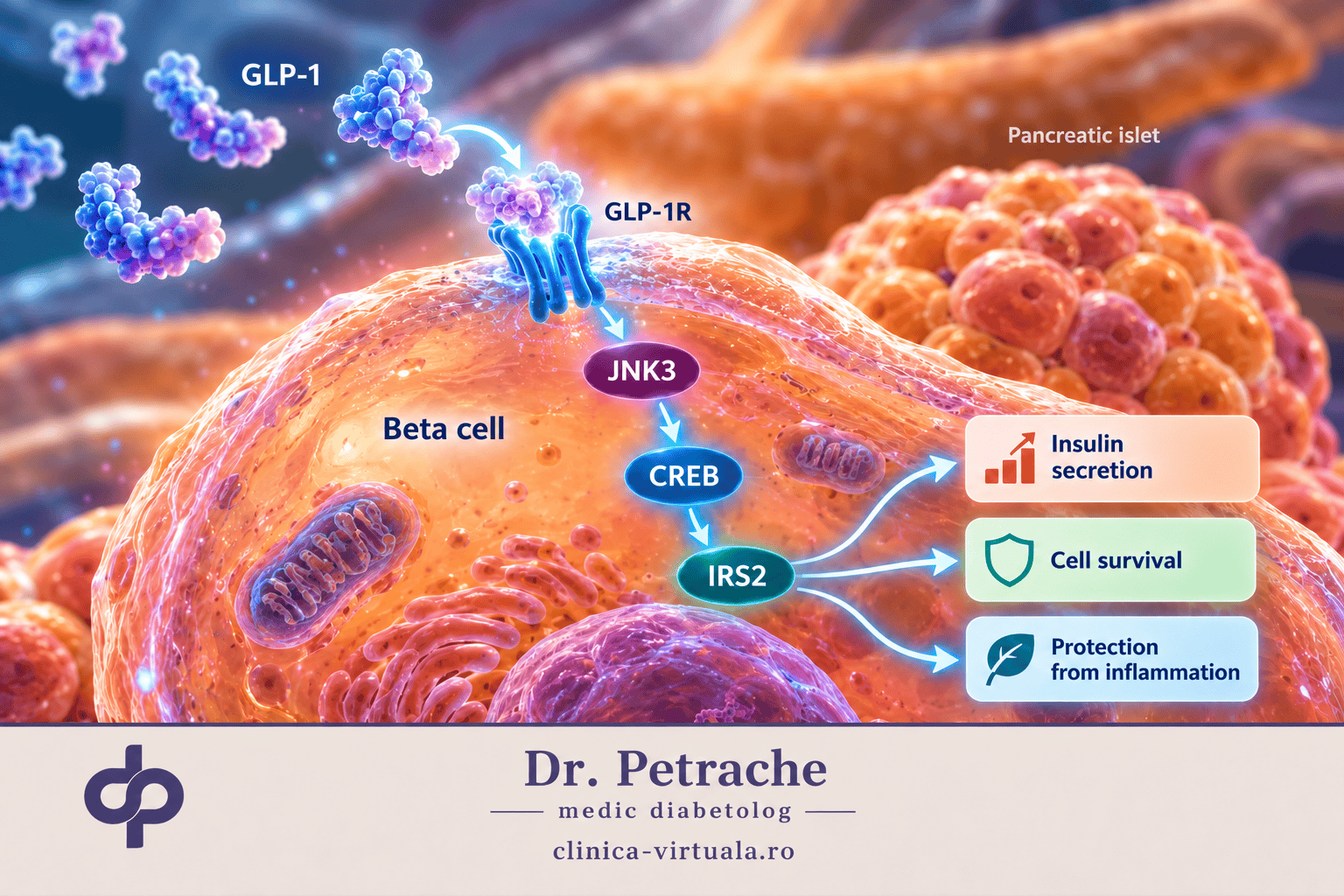
Activation of the GLP-1 receptor triggers several intracellular signaling pathways. One of these involves CREB and IRS2, proteins involved in beta-cell function and survival.
The study suggests the following sequence:
JNK3 → adequate GLP-1R expression → CREB activation → IRS2 → signals supporting beta-cell function and survival.
When JNK3 was deleted or inhibited, GLP-1R expression decreased, CREB activation induced by exendin-4 was reduced, and activation of the GLP-1R/CREB/IRS2 pathway was impaired.
This finding provides a possible molecular explanation for the role of JNK3 in the beta cell’s response to GLP-1.
Can GLP-1 Protect Beta Cells?
This is where the findings become even more interesting.
The researchers exposed cells to inflammatory cytokines, thereby creating an environment of cellular stress.
Under normal conditions, stimulation with exendin-4 exerted a protective effect against apoptosis, or programmed cell death.
However, when JNK3 was absent or inhibited, this protection was substantially reduced or lost.
Similar results were observed in experiments involving human pancreatic islets.
The researchers also investigated the mechanism in an animal model in which low-dose streptozotocin produces beta-cell injury. In this model as well, the protection associated with GLP-1R activation was partially diminished in the absence of JNK3.
JNK3 therefore appears to be more than a protein involved in insulin secretion. It may represent one of the components required for GLP-1 signaling to effectively activate cellular survival mechanisms.
Does This Mean Ozempic or Wegovy Regenerates the Pancreas?
No.
That would be an incorrect interpretation of the study.
The research does not demonstrate that semaglutide, liraglutide, tirzepatide, or other currently available medications regenerate beta cells in humans.
In fact, this was not even a clinical trial involving semaglutide or tirzepatide. Most of the experiments examining GLP-1R activation were performed using exendin-4.
What the study demonstrates is the existence of a biological mechanism through which JNK3 influences the beta cell’s response to GLP-1 receptor stimulation.
There is a very large difference between demonstrating a mechanism in cells or laboratory animals and demonstrating that we can prevent beta-cell loss in a patient.
Protecting Beta Cells Is Not the Same as Regenerating Them
This distinction is worth emphasizing.
Beta-cell protection means attempting to keep existing beta cells alive and functional.
Beta-cell regeneration would mean increasing or restoring beta-cell mass that has already been lost.
The JNK3 study primarily concerns the function, incretin response, and survival of existing beta cells.
It does not demonstrate that JNK3 produces new beta cells, nor does it show that administering a GLP-1 receptor agonist restores lost beta-cell mass in people with diabetes.
What Could This Discovery Mean for Type 2 Diabetes?
In type 2 diabetes, progressive deterioration of beta-cell function is an important component of disease progression.
For this reason, any mechanism capable of improving beta-cell responses to incretins and potentially increasing their resistance to cellular stress is therapeutically interesting.
The study authors propose that JNK3 could potentially become a pharmacological target in the future.
In theory, if JNK3 activity could be selectively increased within beta cells, it might be possible to improve GLP-1R expression or function and enhance certain effects of incretin-based therapies.
For now, however, this remains a research direction, not an available treatment.
There is currently no “JNK3 activator” used in clinical practice that can simply be combined with a GLP-1 receptor agonist to protect the pancreas.
What About Type 1 Diabetes?
This is where the discovery becomes particularly tempting—but also where it must be interpreted with even greater caution.
In type 1 diabetes, the fundamental problem is autoimmunity directed against beta cells.
Even if we found a way to make beta cells more resistant to cellular stress, this would not automatically mean that we had stopped the autoimmune process.
Nevertheless, preserving the remaining beta cells is one of the major areas of type 1 diabetes research.
It would be particularly interesting if future interventions targeting JNK3 or GLP-1 signaling could help protect beta cells that still survive, potentially in combination with treatments that act on the immune system.
However, the current study does not demonstrate that GLP-1 receptor agonists preserve insulin production in people with type 1 diabetes through JNK3.
That hypothesis would need to be tested separately in clinical trials.
Should People With Type 1 Diabetes Take a GLP-1 Receptor Agonist to Protect Their Beta Cells?
That is not the conclusion of this study.
These findings do not justify starting a GLP-1 receptor agonist solely for the purpose of “protecting the pancreas.”
An experimentally observed biological mechanism should not be translated directly into a treatment recommendation.
To establish whether such a strategy actually preserves beta-cell function in humans, prospective clinical trials would be required. These would need to assess endogenous insulin secretion—for example, by monitoring stimulated C-peptide—over a sufficiently long period of time.
Does the Study Tell Us Anything About Mounjaro?
Only indirectly.
Tirzepatide is a dual GIP and GLP-1 receptor agonist, whereas the JNK3 study focused primarily on signaling through the GLP-1 receptor and used exendin-4 in most of its functional experiments.
We therefore cannot automatically assume that all of these findings apply identically to tirzepatide.
A scientific commentary on the study also highlights that it remains to be determined whether a similar JNK3-dependent mechanism exists for the GIP receptor and whether the findings obtained with exendin-4 are reproduced to the same extent with the different GLP-1 receptor agonists currently in clinical use.
What Are the Limitations of the Study?
The most important limitation is that this was not a clinical trial demonstrating beta-cell protection in patients.
A substantial part of the research was conducted in animal models and experimental systems. The use of human pancreatic islets increases the relevance of the findings, but a pancreatic islet studied in a laboratory cannot reproduce the complexity of the entire human body.
In addition, most GLP-1R stimulation experiments used exendin-4. We do not yet know whether all modern drugs acting on GLP-1R produce identical interactions with JNK3.
We also do not know whether pharmacological activation of JNK3 would be feasible, effective, and safe in humans.
JNK3 is also expressed in the nervous system, meaning that the development of any medication targeting this protein would require careful evaluation of effects outside the pancreas.
These questions have also been highlighted in subsequent scientific discussion of the study.
Why Is the Discovery Still Important?
Because it helps us understand more clearly why a beta cell responds to GLP-1.
Incretin-based medications are already among the most important metabolic therapies available today. The next stage of research is not simply about developing molecules that stimulate receptors more strongly. It is also about understanding the intracellular mechanisms that determine the quality of the response.
JNK3 appears to be one of the pieces of this mechanism.
The discovery raises a fascinating question for future research:
Could we make beta cells more responsive to incretin therapy while simultaneously making them more resistant to cellular stress?
If the answer eventually proves to be yes, JNK3 could become a target for a new generation of therapies.
But many steps remain between identifying this pathway and developing a medication.
What Should Patients Take Away From This Study?
This study does not announce a cure for diabetes, nor does it demonstrate pancreatic regeneration.
What it does reveal is an important biological mechanism.
A protein called JNK3 appears to help beta cells maintain an effective response to GLP-1. When JNK3 is absent or inhibited, GLP-1 receptor expression decreases, insulin secretion stimulated through this pathway is impaired, and some of the experimentally observed protective effects on beta cells are lost.
The fact that some of these findings were also reproduced in human pancreatic islets makes the discovery particularly interesting.
However, there is still a considerable distance between these findings and the claim that GLP-1 medications “save the pancreas.”
For now, the most accurate conclusion is less sensational—but scientifically far more interesting:
We have identified another important piece of the mechanism through which beta cells respond to GLP-1 and survive under conditions of cellular stress.
Understanding this piece may eventually contribute to the development of more effective strategies for preserving beta-cell function in diabetes.
The JNK3 Study
The study discussed in this article is: Louzada RA et al., JNK3 regulates β cell responses to incretins in human islets and mouse models, published in the Journal of Clinical Investigation, Volume 136, Issue 1, January 2, 2026. DOI: 10.1172/JCI185707. Original study – Journal of Clinical Investigation
Visiting Romania and need a prescription?
- Forgot your regular medication at home?
- Running out of your chronic treatment?
- Need a prescription for a medication while travelling in Romania?
Dr. Petrache’s Virtual Clinic offers an online prescription service for foreign visitors in Romania.
Simply send us an email with your prescription request and the relevant medical information. If the medication can legally and safely be prescribed, you will receive payment instructions and your prescription will be sent to you electronically.
No clinic visit required.
📧 clinica@diabet-si-nutritie.ro
🌐 Dr. Petrache’s Virtual Clinic – Services for Foreigners
Prescriptions are issued at the physician’s discretion and in accordance with Romanian legislation. Certain medications cannot be prescribed through this service.
Follow us on:
- FaceBook: Diabetes & Nutrition;
- YouTube: Diabetes Facts.